Summer-Dry Climates and Plants: The Mediterranean Basin

Share This!
There are compelling reasons to favor local natives when planning a summer-dry garden. They support native ecosystems and their genetic adaptations to local climates and soils ensure that they need few additional resources to thrive. But there are so many excellent plants from relatively near and far-flung summer-dry parts of the world, and these blend so well with our own native plants, that many gardeners will include at least a few summer-dry non-natives even in a predominantly native garden.

Lavandula stoechas (Spanish lavender), shown here in The Huntington botanical gardens, is native to the western Mediterranean basin and widely cultivated in summer-dry climates.
The choices are many. Although only a little over 2 percent of the world’s land area has dry summers and mild, rainy winters, about 20 percent of all plant species are native to such climates. Together these regions are home to many thousands of species of plants and to several global diversity hotspots where plants are both endemic and threatened, endangered, or rare.
Most of these summer-dry plants are native to the five regions identified as mediterranean by the still widely used, more than 100-year-old Koppen-Geiger climate classification, even in its most recent recalibrations. Others are naturally found along gradients between those regions and hotter or colder, wetter or drier adjacent lands considered semiarid, oceanic, or west coast marine. These climates vary with latitude, elevation, topography, and distance from large bodies of water, but for horticultural purposes most can be considered summer-dry.

Rockrose (Cistus lasianthus) and dwarf fan palm (Chamaerops humilis) from the Mediterranean basin combine well with agaves from Mexico in a Portland, Oregon, garden.
It pays to know something about the geographic origins of a plant when considering it for the garden. Summer-dry plants in the nursery trade are often described as mediterranean natives, but this only suggests the conditions under which these plants naturally grow. Provenance isn’t destiny, but it can provide important clues.
Some plants have a wide and varied distribution and occur in both summer-dry climates and in climates with year-round or mostly summer rainfall. Others are native only to a particular climate but are adaptable enough to be grown in gardens elsewhere. Plants from regions with summer or year-round rainfall may or may not adapt to the heat and dry air of summer in mediterranean climates, even with supplemental water. And many summer-dry plants will struggle in climates with year-round rain.
Climates of the Mediterranean Basin
The Mediterranean basin is by far the largest and most varied region of the world’s summer-dry climates. Summers are dry from the island of Madeira in the Atlantic Ocean to the foothills of the Zagros Mountains in northwestern Iran, a distance of 3,500 miles. This seasonal pattern also extends from coastal northwestern Africa north to the southern foothills of the Pyrenees, Alps, and mountains of the Balkan Peninsula, which intercept cold fronts from continental climates to the north.

A perennial border in the San Francisco Botanical Garden displays plants native to the Mediterranean basin: teucrium, dianthus, santolina, phlomis, and more.
The rugged topography of much of the Mediterranean basin produces a wide variety of subclimates, some of which have quite cold winters and others that are only marginally summer-dry. Summers in the Mediterranean basin generally are coolest nearest the Atlantic Ocean and progressively hotter and drier moving east. Rainfall is greater in the north than in the south, on the western sides of islands and north-south trending peninsulas, and in the mountains.
The number of days without rain in the dry season also varies, the shortest being well inland in the northern Mediterranean region. In south- and east-facing foothills of the Alps rainless periods of a month or more occur only in exceptionally dry years.
Timing of the rainy season varies across the Mediterranean basin, generally beginning in fall in the west and in mid-winter in the east, where rainfall tends to be more intense and concentrated in fewer days. In North Africa the rainy season is usually shorter than in Europe, beginning later in fall and and ending earlier in late winter or spring.
Plants of the Mediterranean Basin
Plants of the Mediterranean basin are found in four main vegetation types or communities. From hottest and driest to less so are: (1) widely spaced, low-growing plants in dry, hot regions with low-nutrient alkaline soils known as garrigue; (2) densely spaced trees and shrubs in more sheltered locations and acidic soils known as maquis; (3) oak-dominated woodlands with evergreen trees and tall shrubs whose small, hard, often waxy (sclerophyllous) leaves are adapted to poor soils, heat, and drought; and (4) conifer forests of mostly pines.

Holm or holly oak (Quercus ilex) is a large evergreen tree with a dense, rounded canopy that casts deep shade. it is adapted to heat, summer dryness, light frost, salt-laden winds, and many different soils. It does need good drainage.
Garrigue is usually found at the lowest elevations. As elevation rises, garrigue may be replaced or accompanied by the taller and more densely vegetated maquis. At higher elevations maquis may grade into oak woodland, which may gradually give way to conifer forest. In addition to elevation, aspect, and exposure to rainfall and winds, vegetation type is determined by how and when land has been affected by many centuries of human use.
Much of the Mediterranean basin was evergreen and deciduous forest before clearing for agriculture, livestock grazing, and harvesting of wood for fuel, trade, and shipbuilding. Sites degraded by human use may shift successively from forest or woodland to maquis to garrigue and even to semiarid steppe. Left alone long enough, they may begin to slowly shift back again.
Maquis
Maquis is the most common vegetation type in the Mediterranean basin today. Often found on lower slopes of coastal hills and mountains from southern Portugal and Spain to the southwestern coast of Turkey, maquis is also native to parts of coastal northwestern Africa and to coastal and western parts of Syria, Lebanon, and Israel. Dominant species within the type and the mix of plant heights vary with local climate and soils, but many plants are widely distributed.

Strawberry tree (Arbutus unedo) is a large evergreen shrub or small, multitrunk tree with leathery, dark green leaves, small white flowers in spring, and fruit that matures from yellow to orange to red. Found in both maquis and garrigue, it is adapted to both acidic and alkaline soils and needs excellent drainage.
Dominants among the taller shrubs and trees of the maquis are the shrublike evergreen kermes oak (Quercus coccifera); shrubby forms of the usually much larger holm or holly oak (Q. ilex); the routinely harvested cork oak (Q. suber); the mid-sized, multitrunk mastic (Pistacia lentiscus); and the highly drought-tolerant carob tree (Ceratonia siliqua).
Dominant in oak woodland as well as maquis, holm oak is native to the central and western Mediterranean basin from Portugal and Spain to western Turkey. Cork oak is native primarily to the western basin, especially Portugal and Spain. The native range of carob extends to hotter and drier parts of the Middle East, including the semiarid Mediterranean coast of Egypt.
Strawberry tree (Arbutus unedo), tree heather (Erica arborea), and myrtle (Myrtus communis) are other common components of the tall maquis. Tree heather is also native to summer-rainfall highlands of East Africa. Myrtle is also found in parts of Pakistan that experience summer monsoons. Strawberry tree is restricted to summer-dry climates of the Mediterranean basin.

Cercis siliquastrum is a small, deciduous, often multitrunk tree with purplish pink flowers in early spring followed by bright green leaves and pendant, purplish seedpods. As an understory tree, it prefers some protection from drying winds and from the hottest afternoon temperatures.
Also common in Mediterranean maquis are Judas tree (Cercis siliquastrum), native to open woodlands as well as maquis from southern France, Italy, and Greece to Iran, Iraq, and Afghanistan; Aleppo pine (Pinus halepensis), native throughout the Mediterranean basin; and dwarf fan palm (Chamaerops humilis), native to the western Mediterranean basin, including North Africa. Dwarf fan palm is one of only two palms native to the Mediterranean basin (the other is the date palm Phoenix theoprasti, found in damp coastal ravines on the island of Crete and in coastal southwestern Turkey).
Wild olive or oleaster (Olea europaea ssp. europaea var. sylvestris) and feral plants of the cultivated olive (O. europaea ssp. europaea var. europaea) are found in both maquis and garrigue plant communities. Olive trees have been in cultivation for thousands of years and their origins are uncertain, but they are believed to be native primarily to the eastern Mediterranean, especially Turkey.

Non-fruiting cultivars of the olive tree, here the fruitless ‘Wilsonii’ at The Huntington botanical gardens, are grown as drought- and heat-tolerant ornamentals in summer-dry climates.
Lower-growing plants of the maquis are common where canopies are more open. Rockrose (Cistus sp.) and oleander (Nerium oleander) are common here. Rockroses are especially common in Spain, Morocco, and Turkey but are native throughout the region.
Oleander, a fixture in cultivated summer-dry landscapes worldwide, is native to the Mediterranean basin, the Arabian peninsula, and southern Asia, including parts of southwestern China. Although tolerant of considerable heat and drought, oleanders tend to grow in rocky stream beds or seasonal washes.

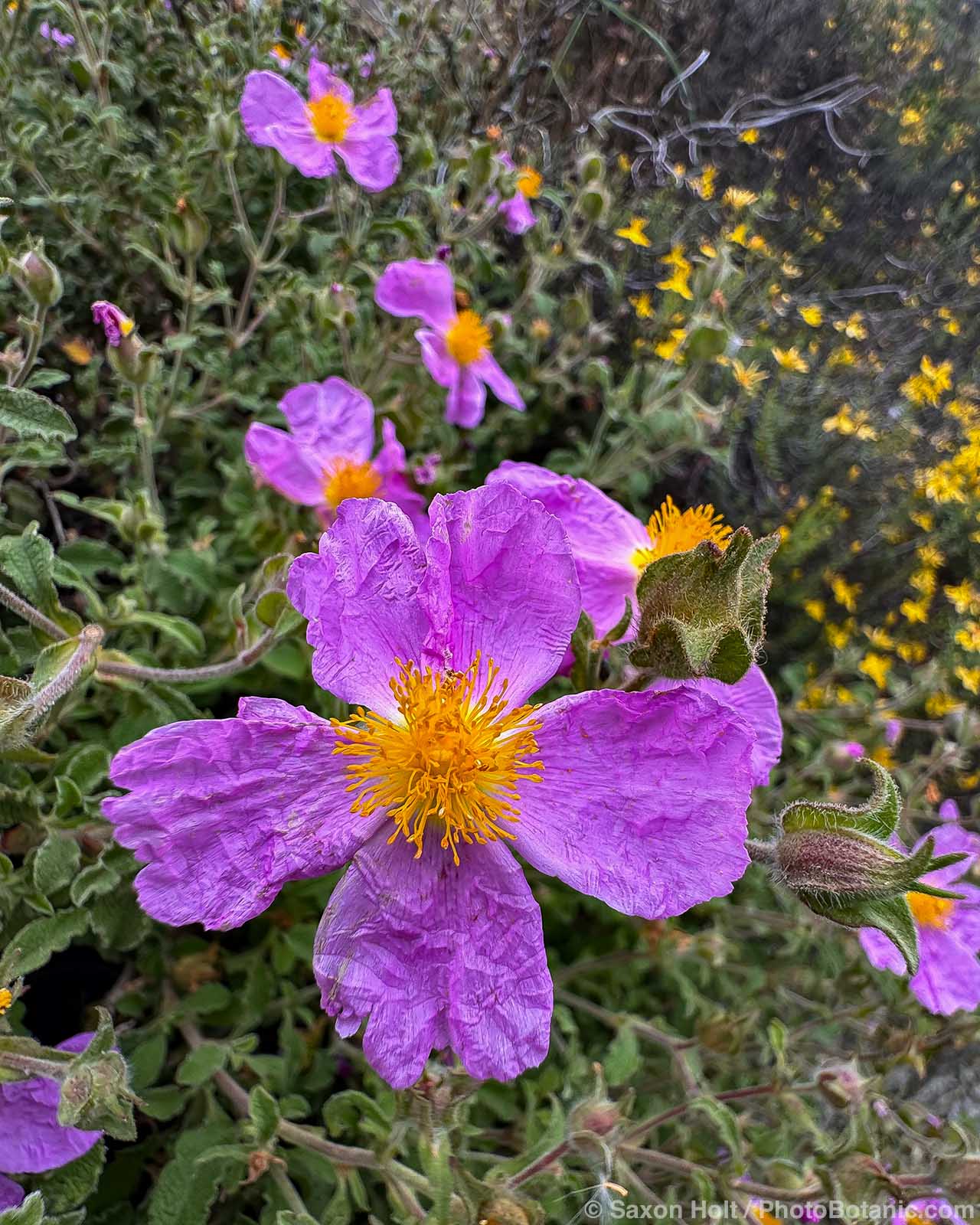
Rockroses (Cistus sp.) are summer-flowering shrubs for low-nutrient, fast-draining soils and sunny locations. C. incanus, shown here, is a natural hybrid of C. albidus and C. crispus, all of which are native to maquis and garrigue in the western Mediterranean basin.
Garrigue
Garrigue occurs in the hottest and driest parts of the Mediterranean basin, usually in rocky, alkaline, limestone-derived soils near the coast and increasingly common moving east. Because garrigue has traditionally been used for grazing sheep and goats, many plants that still persist here are spiny, tough, or aromatic, traits unattractive to livestock.
Many plants of garrigue vegetation are well known to gardeners in summer-dry climates, where they are often grown in richer soils and with summer irrigation. Rosemary, lavenders, Jerusalem sage (Phlomis fruticosa), artemisias, rockroses, sages (Salvia sp.), and culinary plants such as oregano, marjoram, and thyme are common components of garrigue vegetation. Some larger shrubs and small trees found in maquis also occur in garrigue, usually in their shrubbier forms.

Asphodelus albus, white asphodel, is a summer-dormant and deciduous herbaceous perennial with a basal clump of blue-green grasslike leaves and leafless stems bearing bright white, pink-striped, tubular flowers in spring. It does best in sunny locations and well-drained, alkaline soils.
In openings among the shrubs and perennials are bulbs and other geophytes that bloom in spring or fall: narcissus, crocus, cyclamen, hyacinth, asphodels, and tulips are all native to the Mediterranean basin. Asphodels (Asphodelus sp.) are native from the western Mediterranean to the Middle East and the summer-dry western Himalaya.
Irises are found on rocky slopes in garrigue shrublands, especially in the eastern Mediterranean: the winter-blooming Iris unguicularis; the bulbous I. xyphium (Spanish iris), the yellow- or violet-flowered I. lutescens, and the natural hybrid I. x germanica, the presumed source of modern bearded iris cultivars, are all adapted to hot, well-drained, sunny sites and dry summers.
A large number of summer-dormant terrestrial orchids (Ophrys, Orchis, Serapias, Anacamptis, Cephalantera, Epipactis, and others) often grow in rocky garrigue used for low-intensity livestock grazing, which apparently maintains the open areas and disturbed soils favored by these tuberous-rooted geophytes.
Woodland and Forest
Centuries of wood harvesting and clearing for agriculture along with increasing human populations have decimated woodlands and forests throughout the Mediterranean basin. While only a small fraction of the ancient forests remain, there still are substantial stands of evergreen and deciduous trees, especially in Spain, Morocco, and the Balkans. Woodlands and forests are also still found in France, Italy, and Algeria. Remnants are found almost everywhere.

Aleppo pine (Pinus halepensis), shown here in a northern California garden, is a fast-growing, heat- and drought-tolerant tree native to much of the Mediterranean basin. Aleppo pine thrives in almost all soils and microclimates.
Woodlands and forests from west to east and north to south vary along with climate and soils. Milder temperatures and higher rainfall in much of the western and northern Mediterranean basin support evergreen sclerophyllous woodlands dominated mostly by holm oak and cork oak. Dominant in western Mediterranean conifer forests are Aleppo pine and the related maritime pine (Pinus pinaster). Italian stone pine (P. pinea), long cultivated and naturalized throughout the Mediterranean basin, is believed to have originated in Spain and Portugal.

Italian or Mediterranean stone pine (Pinus pinea) has been cultivated for its wood and edible seeds (“pine nuts”) for thousands of years and is found in gardens and parks throughout the world today.
In the central Mediterranean a mix of both western and eastern species combines with alpine and central European species, especially in mountainous areas. Evergreen oaks and pines are joined by deciduous trees such as downy oak (Quercus pubescens) and European hornbeam (Carpinus betulus). Low-elevation oak and Aleppo pine woodlands dominate the coastal margins.
In the east, from Turkey to Syria, Lebanon, and Israel, forests are generally found only at the highest elevations where dominant species include the endemic Turkish pine (Pinus brutia) and cedar of Lebanon (Cedrus libani). Woodlands here are dry, dominated by kermes oak, Tabor oak (Quercus ithaburensis), and Pistacia species, and often degrade into lightly vegetated scrubland.

Share This!
Related Articles

By: Nora Harlow

By: Saxon Holt

By: Nora Harlow