Mediterranean Fan Palm
Share This!
In the dry, rocky, low-nutrient soils of exposed coastal cliffs and mountain slopes the Mediterranean fan palm Chamaerops humilis forms low, shrubby, five- or six-foot mounds that, from a distance, are barely distinguishable from the rest of the sun-baked garrigue community. In more fertile, protected island valleys, and in the relative luxury of garden cultivation, its prominent 15- to 20-foot presence is hard to miss.

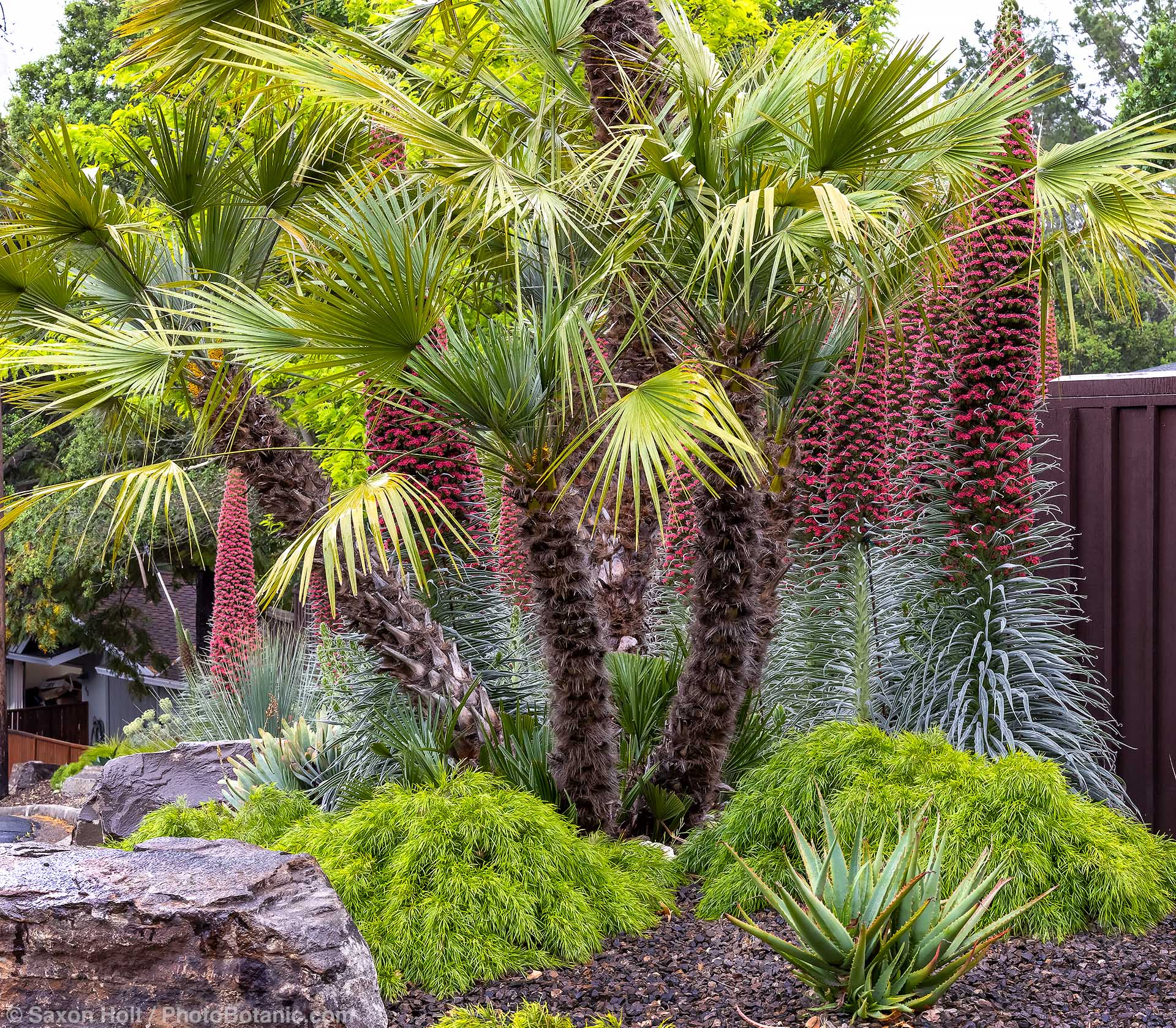
Multi-trunk Chamaerops humilis in a front-yard landscape by Enchanting Plantings
Two varieties of Chamaerops humilis are recognized. Variety humilis is native intermittently along the coast from Portugal and Spain to western Italy and the major western and central Mediterranean islands. It is also native to north-coastal Morocco, Algeria, and Tunisia. This variety has green, deeply segmented palmate leaves with extremely sharp spines along leaf petioles. It is almost always found at low elevations.
Chamaerops humilis var. argentea has silvery blue, waxy leaves on a seemingly slower-growing and somewhat smaller plant. It is native to the Atlas Mountains of northern Morocco and Algeria at elevations up to 6,000 feet. In the horticultural world this variety is commonly referred to as var. cerifera or simply as cerifera, a name published later than variety argentea and thus, at best, a synonym or common name.

Chamaerops humilis var. argentea in a Portland, Oregon, garden designed by Craig Quirk
The two varieties share characteristics such as multiple trunking, palmate leaves on spiny petioles, and dense clusters of small, bright yellow, three-lobed spring flowers that develop into clusters of shiny brown, oval, one-seeded drupes. Flowers are held upright on short stems at the top of the trunk and are mostly hidden by the leaves. Old leaf bases persist, forming a loose brown skirt around the trunk.
In the garden both varieties are best in full sun or light shade and accept many different soil types as long as they have good drainage. Both are tolerant of dry conditions but grow faster and look better with consistent moisture. Established plants of both varieties are cold hardy as long as freezing temperatures don’t dip too low or last too long. Both can be maintained as single-trunk specimens by regularly pruning out new stems that develop at the base.
Several cultivars are sometimes available. ‘Vulcano’ has a denser, tighter, less airy habit and few if any spines on leaf petioles.

Share This!
Related Articles

By: Nora Harlow

By: Saxon Holt