Myrtus communis
Share This!
No wonder it’s called common myrtle. Widely cultivated since ancient times, its natural distribution is uncertain, but Myrtus communis is believed to be native throughout the entire Mediterranean basin as well as east from the Levant through western Asia to the foothills of the Himalaya in northwestern Pakistan.

Myrtus communis retains its lush, green appearance even in hot, dry times and places. Shown here is the cultivar ‘Compacta’ at Leaning Pine Arboretum in San Luis Obispo, California.
Within such a broad distribution this adaptable shrub is found in varied climates from classically mediterranean to semiarid and even summer-monsoon. It thrives in full sun or as understory and in mildly acidic to mildly alkaline, rocky or sandy to clayey or chalky soils. Its only requirements seem to be reasonable drainage and moderate winter temperatures. It can be grown where temperatures occasionally fall well below freezing but only if such freezes are not prolonged. Highly tolerant of drought, it also does well where exposed to drifting sea spray.
Lacking a flashy floristic display, Myrtus communis doesn’t often receive the attention it deserves in the popular garden press. It excels in the garden as an always good-looking evergreen backbone plant, as a definer of spaces, and as a foil for plants with larger or different colored leaves. It accepts any amount of clipping and can be trained as a small tree, a hedge, or even maintained as topiary or bonsai. Its dense foliage makes an effective screen.

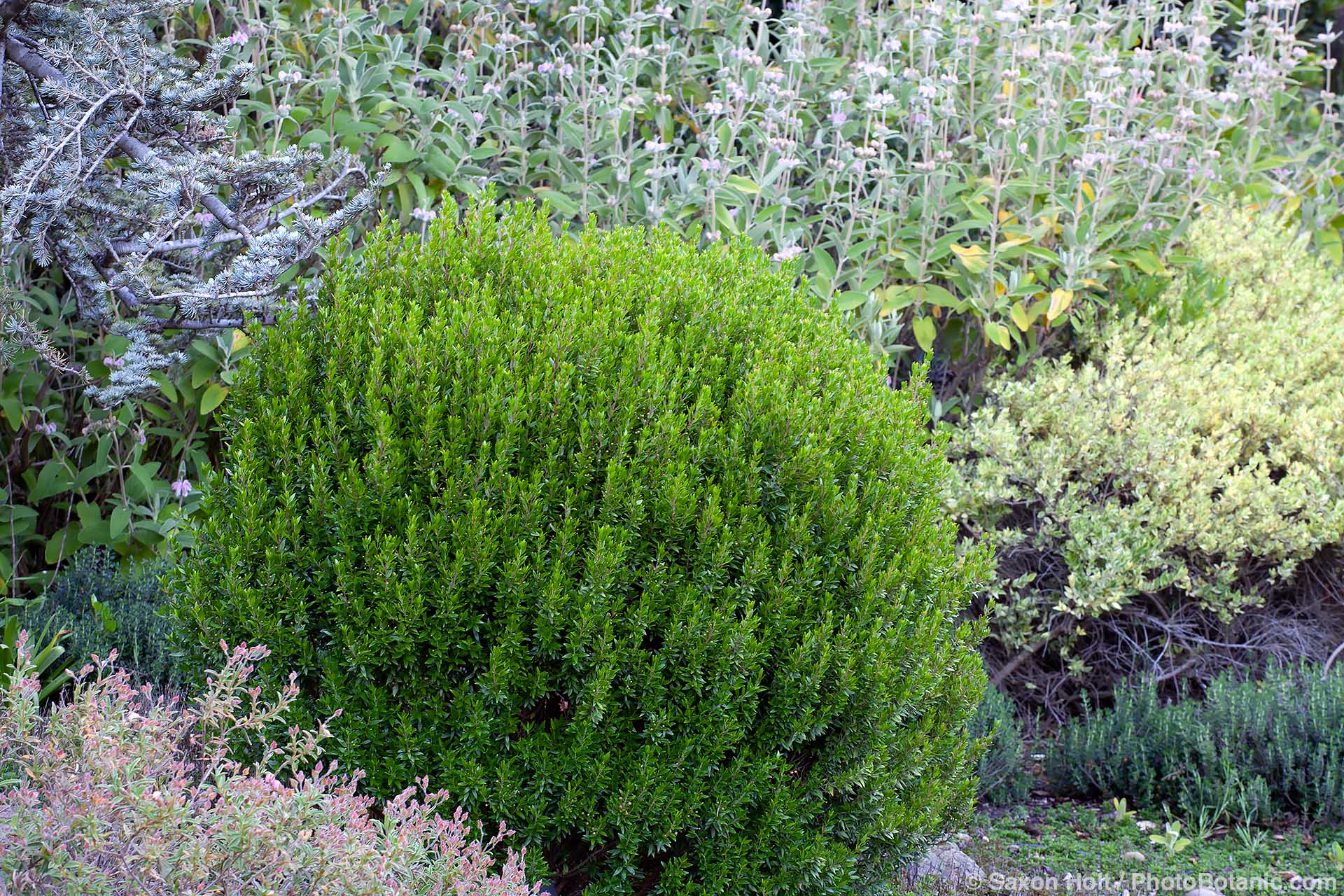
The small leaves and softly rounded form of Myrtus communis ‘Variegata’ accentuate the upright stems of Phlomis italica behind.
There are two subspecies of Myrtus communis: subspecies communis and subspecies tarentina. The subspecies differ primarily in mature size, foliage density, and leaf shape and size. A rare form of subspecies communis often referred to by the synonym M. communis subsp. baetica is not a recognized subspecies. That plant is often marketed as Myrtus communis ‘Boetica’.
Plants offered simply as Myrtus communis usually are selections of subspecies communis. Over time this shrub can reach 10-12 feet tall and almost as wide, but it is slow-growing and remains a medium-sized shrub for many years. The oval to pointed, glossy, mid-green leaves are aromatic when crushed and small enough that shearing does little damage to their groomed appearance.

Myrtus communis ‘Compacta’ makes a fine sheared hedge, as shown here at the demonstration garden of the Western Municipal Water District, Riverside, California.
Late spring to early summer white flowers are small, fragrant, and five-petaled with prominent yellow-tipped stamens. The berries that follow start out green, turn yellow, and mature to a rich dark bluish purple. Bees love the flowers and the berries are great favorites of birds.
Subspecies tarentina, also slow-growing, is 3-4 feet tall and wide. It is often offered as Myrtus communis ‘Tarentina’. This is a densely foliaged plant, rounded in shape, with smaller leaves and smaller flowers that are pinkish white. It usually forms white berries. This is an extraordinarily tidy plant, compact enough to be grown for some years in a large container. It seems to be more tolerant of colder climates, where its leaves take on a deep purplish cast in winter.
Several cultivars of these two subspecies are often available in nurseries and online, but the naming can be confusing. Selections of both subspecies are named ‘Compacta’ and ‘Variegata’. ‘Microphylla’, the cultivar name of a small-leaved selection of subspecies communis, is often casually applied in the nursery trade to small-leaved plants of subspecies tarentina.
Only subspecies communis has a dwarf variegated selection called ‘Compacta Variegata’. ‘Buxifolia’, another cultivar of subspecies communis, has extremely small leaves and a groundcovering habit at 2-3 feet tall and twice as wide.

Myrtus communis ‘Boetica’ is attractive as a single specimen and in multiples can make an effective windbreak or a dense screen.
Myrtus communis ‘Boetica’ is an unusual 4- to 8-foot tall shrub with a spiraling arrangement of glossy, finely pointed, dark green leaves densely packed on upright, oddly contorted branches. White flowers are followed by dark bluish purple berries. This plant is especially tolerant of heat and drought and is often grown in desert climates.

Share This!
Related Articles

By: Nora Harlow

By: Saxon Holt

By: Nora Harlow