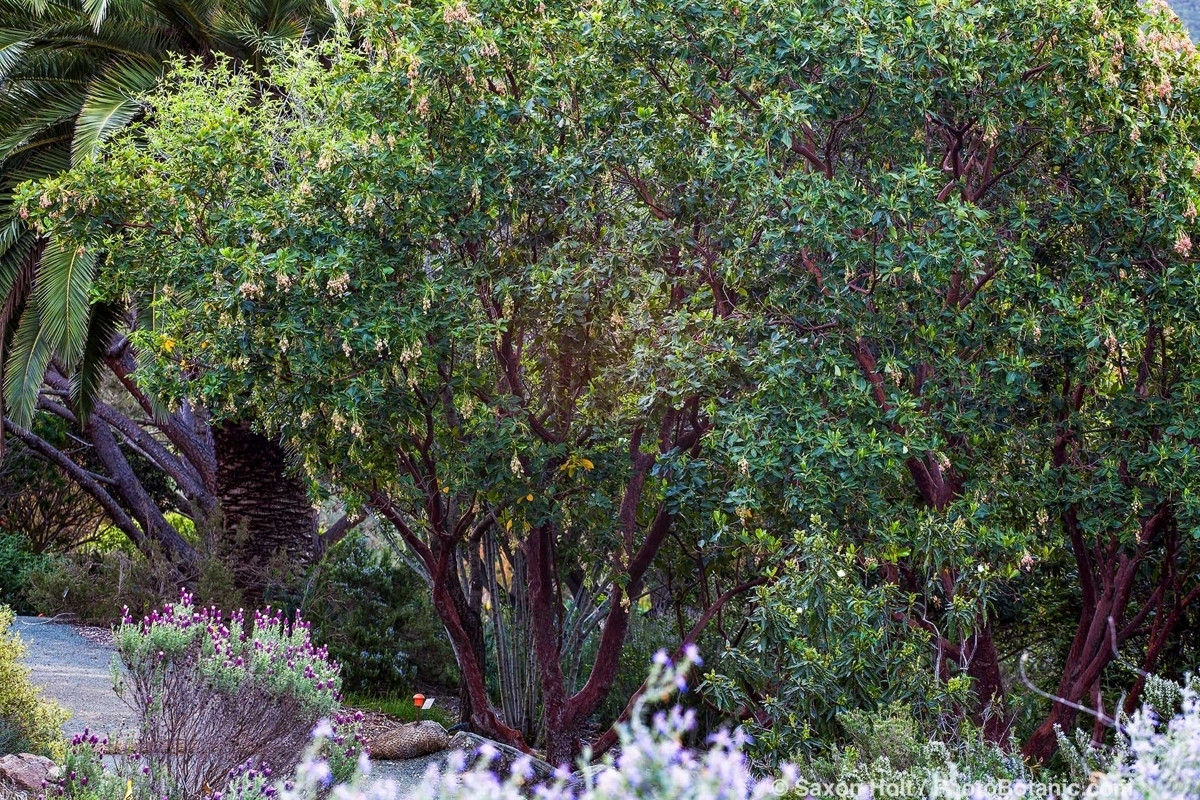
Mediterranean Euphorbias

Share This!
With more than 2,100 species and a near-global native distribution, euphorbias are a varied lot. Some are leafy shrubs or perennials while others are succulents that could be mistaken for cacti. Some are flat, almost mosslike mats and a few are mid-sized to large trees. Lumped together in the same genus primarily by a unique inflorescence and a sticky, milky-white, more or less toxic sap, euphorbias are found in almost every part of the world except the polar regions.
Euphorbia myrsinites with Aloe buhrii x reynoldsii (center), A. glauca (left), and A. microstigma (right) in the Ruth Bancroft Garden, Walnut Creek, California
More than 100 euphorbias are native to the Mediterranean. Some are widely distributed, but many are localized endemics, native to a single island, peninsula, or mountain range. Most are leafy shrubs and subshrubs or perennials, although several are semi-succulent with fleshy leaves and stems and a woody base.
Euphorbias are native throughout the region but diversity is highest toward the eastern Mediterranean, especially in Turkey, Syria, and northwestern Iran. Most are found in rocky, poor, and well-drained soils on coastal bluffs and dry mountain slopes, in open scrublands and pine forest clearings, and in shrublands on desert margins.

Euphorbia characias subsp. wulfenii (across the path from bench) in the Los Angeles County Arboretum
In cultivation Mediterranean euphorbias are especially suitable for beds and borders or rock gardens. Their colors, textures, and forms complement and contrast effectively with other plants and their cultural requirements are minimal. Needing only full sun to part-day light shade and well-drained soils, they are excellent plants for summer-dry gardens.
Two semi-succulent species, Euphorbia myrsinites and E. rigida, have long been popular with gardeners. Both have blue-gray leaves spirally arranged on fleshy stems and inconspicuous flowers surrounded by chartreuse bracts.

Euphorbia myrsinites is a wonderful but weedy, semi-succulent perennial that accents the features of other plants, here the grass Muhlenbergia dubia and Otatea acuminata subsp. aztecorum, a weeping bamboo from Mexico.
Euphorbia myrsinites, a sprawling plant 6-8 inches tall and up to two feet wide, has come to be considered a noxious weed in much of western North America. It should never be planted near wildlands or open space, even where its sale and use are legal, but if you have the right space and are willing to manage it, E. myrsinites can add a charming informality. Seeds are thrown up to 15 feet as it leapfrogs about the garden, popping up in places both where it does and where it does not contribute to the garden’s design.
Euphorbia rigida is more upright, to two feet tall and three feet wide, but otherwise similar to E. myrsinites with blue-gray leaves and chartreuse bracts at flowering. Native from Portugal to Turkey, it may self-sow but generally stays where you plant it. As with other evergreen shrubby or herbaceous euphorbias, self-seeding can be controlled by cutting out flowering stems before they go to seed. Cut stems to the base to make room for new stems that will flower the following year.

Euphorbia rigida in a Portland, Oregon, garden
Euphorbia characias is an upright evergreen shrub with bluish gray-green leaves on unbranched stems and flowerheads with chartreuse bracts. Two subspecies are native to the Mediterranean. Subspecies characias, found from Portugal to Crete, is three feet tall and wide. The more widely grown subspecies wulfenii is a larger plant, 4-5 feet tall, and native from southern France to southwestern Turkey. E. characias is an exceptionally drought tolerant species, showing no signs of stress with infrequent to zero summer irrigation. Both subspecies and their many cultivars are good candidates for dry or mostly dry gardens.
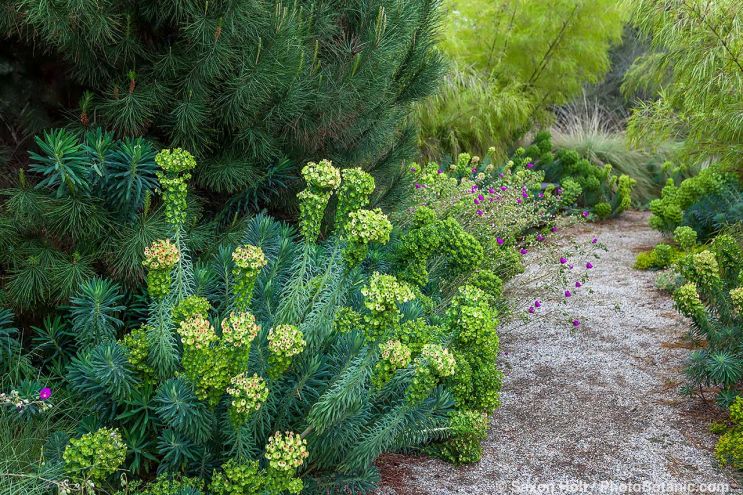
Euphorbia characias ‘Bruce’s Dwarf’, a compact selection of E. characias subsp. wulfenii, shown here at the Huntington Botanical Gardens, San Marino, California
For a quite different look, several hybrids offer deep purple leaves and inflorescences with chartreuse or purple bracts. Most are crosses involving Euphorbia characias and E. amygdaloides, which has matte green leaves, purplish beneath, that take on burgundy tones as temperatures cool in late fall. E. x martinii, a natural hybrid of E. characias and E. amygdaloides, retains this characteristic, its dark gray-green leaves turning purplish red in cooler weather. Leaves of the E. x martinii cultivar marketed as Miner’s Merlot turn a blackish burgundy as temperatures drop.
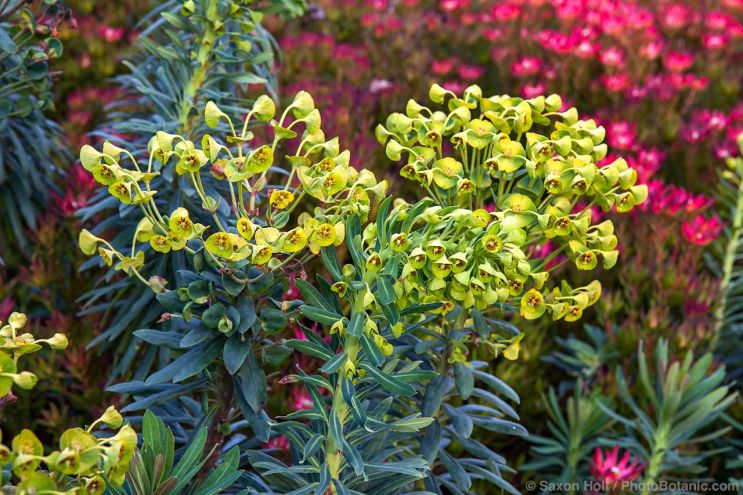
The dark gray-green leaves of Euphorbia x martinii take on purplish tints in cooler weather.
Other cultivars with leaves that change color with the seasons are ‘Ruby Glow’, a hybrid of Euphorbia characias and E. amygdaloides; Redwing (‘Charam’), a hybrid of E. amygdaloides and E. x martinii; and Blackbird (‘Nothowlee’), a genetic mutation of Redwing. Blackbird’s lime green bracts also may darken to purplish black as they age if the plant is grown in full sun.
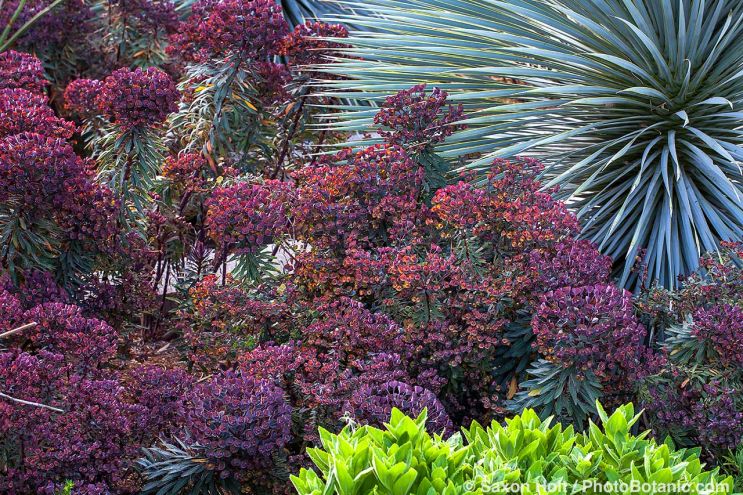
Euphorbia ‘Nothowlee’, here shown in the Huntington Botanical Gardens, has dark gray-green leaves and chartreuse bracts that can turn purplish black if the plant is grown in full sun.
For those new to euphorbias it must be mentioned that all exude a milky white fluid when stems are cut. Shrubby euphorbias usually are maintained by cutting flowering stems to the ground before or as soon as they go to seed. This is a messy task as the sticky fluid flows surprisingly fast. The fluid is a latex that varies in toxicity from one species to another but can cause mild to severe burning of skin and vision loss if it makes contact with the eyes. You will want to wear disposable gloves, meticulously avoid touching bare skin or eyes, and clean your shears after pruning.

Share This!
Related Articles

By: Nora Harlow

By: Saxon Holt