The first rains have started. The garden reawakens, reminding us how glorious rain can be and that water is a precious resource. If you’ve never taken a walk in a heavy rainstorm, we highly recommend it. Slip an inexpensive pair of rain pants over your trousers, grab your waterproof coat, pull on your garden boots, and head out with an umbrella. You don’t need anything fancy—you’re not trekking into the wilderness, just taking a stroll around the neighborhood. You’ll thank us later.
November is one of our favorite months in the garden, primarily for the stunning fall color. If you’re looking for hundreds of plant photographs within our website, simply search “Fall Color” on our site to find a ready-made list of vibrant options for your yard.
We also love November because the soft, damp soil makes it the perfect time for active garden work. Whether you’re adding new plants, putting in spring bulbs, or reworking your landscape design, moving plants is much easier this time of year.
As you plan your autumn garden projects, we urge you to consider capturing that precious rainfall before it leaves your property. Rerouting a roof gutter downspout allows water to percolate into the soil and replenish groundwater instead of washing away into a storm drain. Below, we’ve gathered a few practical design tips and examples—including a personal DIY project—to help you get started.
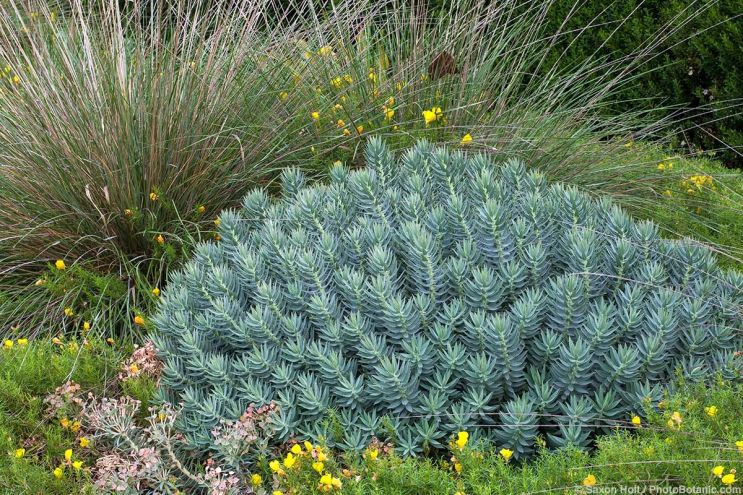
In cultivation, Mediterranean euphorbias are especially suitable for beds and borders or rock gardens. Their colors, textures, and forms complement and contrast effectively with other plants, and their cultural requirements are minimal. Needing only full sun to part-day light shade and well-drained soils, they are excellent plants for summer-dry gardens.
November is a great time to add a simple rain garden or bioswale to your own garden. Rerouting roof runoff into your garden allows water to percolate into the soil, replenish groundwater, and help provide long-term moisture when summer returns.
(Note: We use “bioswale” and “rain garden” somewhat interchangeably for this basic idea of capturing water before it flows off-site into storm drains. There are lots of excellent resources online. Any large system requiring deep digging, hardscape changes, or erosion control is best handled by a professional designer who recognizes the pitfalls.)
The first three examples below were all designed and installed by professionals as part of a complete garden makeover. However, they are fairly small gardens and might inspire you to envision something on a modest budget.
This dry creek rainwater bioswale reroutes the roof drain and runs between a mixed border along the garage and a Carex lawn meadow made up of C. pansa, C. praegracilis, and C. divulsa.
We have added an arrow to show how a rain garden collects water from a roof, directs it into a dry gravel percolation ‘pond,’ and carries it through the garden. Design: Urban Water Group
This front yard garden incorporates a bioswale to capture water, with Small Cape Rush (Chondropetalum tectorum) and an African sumac tree (Searsia lancea.) Design: Studio Grey Green.
The last example comes with a confession. Saxon here, stepping out of our collective “we” voice for a moment. After years of photographing examples and imagining that anyone can do this, I finally practiced what we preach. I channeled a gutter downspout under a pathway and created a very modest, DIY creek feature running through my front yard to the street.
Get more ideas in our book: Gardening in Summer-Dry Climates
In this month’s intro, we created a link to our own website with a group of plants for fall color, and we think this is a great time to remind you that our website has a database of plants.
Timely Links
We would love to hear about any resources you would like to pass along. We all get these snippets from our news feeds and inboxes. Let’s share the best, and we will keep the running list so you can find them later on the Links We Like page.
Saxon Holt is a photojournalist and sole photographer of more than 30 garden books, including the award winning books Plants and Landscapes for Summer-Dry Climates, The American Meadow Garden, and Hardy Succulents. He is the Director of the Summer-Dry Project, a Fellow of the Garden Writers Association, and owner of the PhotoBotanic Garden Library.