Rockrose
Share This!
Rockroses (Cistus species) are so glorious in bloom and their leaves are so delightfully aromatic on hot summer days that one might expect them to be featured in every garden in summer-dry climates. That they are not is a bit of a mystery but one that perhaps can be explained.

Cistus creticus flowering on a cliff in Crete
Around 20 species of Cistus and at least as many natural hybrids are native to the Mediterranean basin and these are the plants we are considering here. These numbers do not include the seven to a dozen species of Halimium now recognized by taxonomists (but not, it seems, by many nurseries) as included in the genus Cistus. Nor do they include the several natural hybrids between Cistus and Halimium known colloquially also as rockrose and botanically as xHalimiocistus.
Plants in all three genera are spring to early summer flowering evergreen shrubs adapted to summer drought and nutrient-poor, rocky or sandy soils. Halimiums and the xHalimiocistus hybrids are native to the western Mediterranean basin. Cistus species and their natural hybrids are more widely distributed from the lower mountain slopes of the Canary Islands to the south-facing foothills of the Caucasus Mountains. The natural distributions of two, C. salviifolius and C. creticus, extend well into the Levant.
As are many plants native to summer-dry climates, Cistus are partially deciduous in the hottest, driest times of year. Unlike many other drought-deciduous plants, they do not revive from hard cutting back and if watered in summer to maintain more green their lifespan is greatly shortened. If drainage is poor, water at any time of year can kill them.
What this means is that gardeners and garden designers must either resign themselves to the late-summer appearance and artificially short life of many Cistus species or place them where they will not overrun their allotted space and where summer leaf drop is not a drawback. Rockroses need excellent drainage, plenty of sun, no heavy pruning, no fertilizer, and little to no summer water. When their simple but non-negotiable needs are met, rockroses can be exceptionally beautiful, reasonably long-lived shrubs and they thrive with little attention from the gardener.
Lester Hawkins, founder with Marshall Olbrich of Western Hills rare plant nursery in Occidental, California, got close to the heart of the matter. In the Fall 1978 issue of Pacific Horticulture magazine, he wrote:
“I think we should recognize that no rock roses are really suitable for the small, tightly controlled garden. These are plants for roomier and airier places, rocky hillsides, for example, or along driveways to country houses. Given these appropriate and spacious settings, all the so-called drawbacks disappear and they become wildly picturesque and singularly beautiful shrubs. . .”

Cistus creticus clothes a bank in a garden on the island of Corfu, Greece.
Proper placement depends in large part on the garden maker’s familiarity with the natural habits of the various Cistus species and cultivars. The species are divided botanically into white-flowered and pink-flowered plants, but plant size and shape are more important to those who design and maintain gardens. Cistus species and cultivars fall roughly into three categories: tall, upright shrubs, midsized mounding shrubs, and low, sometimes widely spreading groundcovers. Not all fall neatly into one category or another.
Tall, upright plants tend to become leggy with age and are best placed among midsized mounding shrubs that emphasize their height, show off their flowers, and downplay their loss of leaves near the base. Midsized mounding plants are effective sited among other dry-loving plants of similar size and habit, which can require a rather large space to carry out well. Low groundcovers are effective spilling down banks or cascading over rocks and walls but must be placed where their ultimate width can be accommodated with little to no pruning.

White-flowered mounding rockroses massed on a slope in the San Francisco Botanical Garden
Tall, Upright Shrubs
There are relatively few tall, upright rockroses. The most commonly cultivated probably is the hybrid cultivar Cistus x ladanifer ‘Blanche’, which is often described as 4-6 feet tall in nursery catalogs but can reach 8 feet under ideal conditions.
One of the parents of ‘Blanche’, C. ladanifer, is 5-8 feet tall and slightly less wide. It is native to sandy, acidic and volcanic soils exclusively in the western Mediterranean basin and primarily in Portugal and Spain. The other parent, C. ladanifer subsp. sulvatus (formerly C. palhinhae), is smaller and bushier, with branches retained lower to the ground. It is endemic to rocky limestone cliffs along the coast of southwestern Portugal.
All three shrubs have impressively large white flowers. All three have narrow, dark green, smooth-margined leaves, gray-felted or whitish beneath. Leaves and stems are coated with the fragrant resin known as labdanum, which gives the leaves a shiny appearance and a strong balsamic fragrance when warmed by the sun. Cistus flowers are largely unscented.

Often confused with and marketed as ‘Blanche’, Cistus x aguilarii is a natural hybrid between C. ladanifer and C. populifolius native primarily to northern Morocco, the Iberian Peninsula, and southern France. This is a vigorous, white-flowered shrub, larger, denser, and even more floriferous than ‘Blanche’, and arguably more attractive year-round. The most popular form is the cultivar ‘Maculatus’, prized for its especially large flowers with the deep red petal markings inherited from C. ladanifer.
The parent species C. populifolius is 5-6 feet tall and slightly less wide with white flowers and dark green leaves with undulating margins that are sticky with resin. Along with C. ladanifer and few others, C. populifolius is naturally found in acidic soils and tends to become chlorotic in soils that are alkaline. Cistus x aguilarii adapts to most soils, both mildly acidic and mildly alkaline.
Cistus x cyprius is a 4- to 6-foot tall and wide natural hybrid of C. ladanifer and C. laurifolius. It is native to rocky or sandy, acidic soils where the two parent species occur together in more mesic habitats of the mountains of northern Morocco, Portugal, and Spain. It also occurs along the coast in far northwestern Spain.
The parent species Cistus laurifolius is similar to C. ladanifer but with larger leaves and smaller flowers. C. x cyprius is also similar but with a denser habit. It bears large white flowers with reddish petal markings sometimes found on plants with C. ladanifer in their genetic makeup. As with C. ladanifer, stems and leaves of C. x cyprius and the new leaves and young shoots of C. laurifolius are sticky with resin and aromatic on hot summer days.

Cistus x cyprius ‘Troubadour’ in the San Francisco Botanical Garden
Midsized Mounding Shrubs
Most rockroses probably could be described as midsized and mounding. Some are quite low-growing and could be considered groundcovers if they spread more widely. These are possibilities for smaller gardens. Larger mounding shrubs need more space for best effect and to avoid the need for pruning.
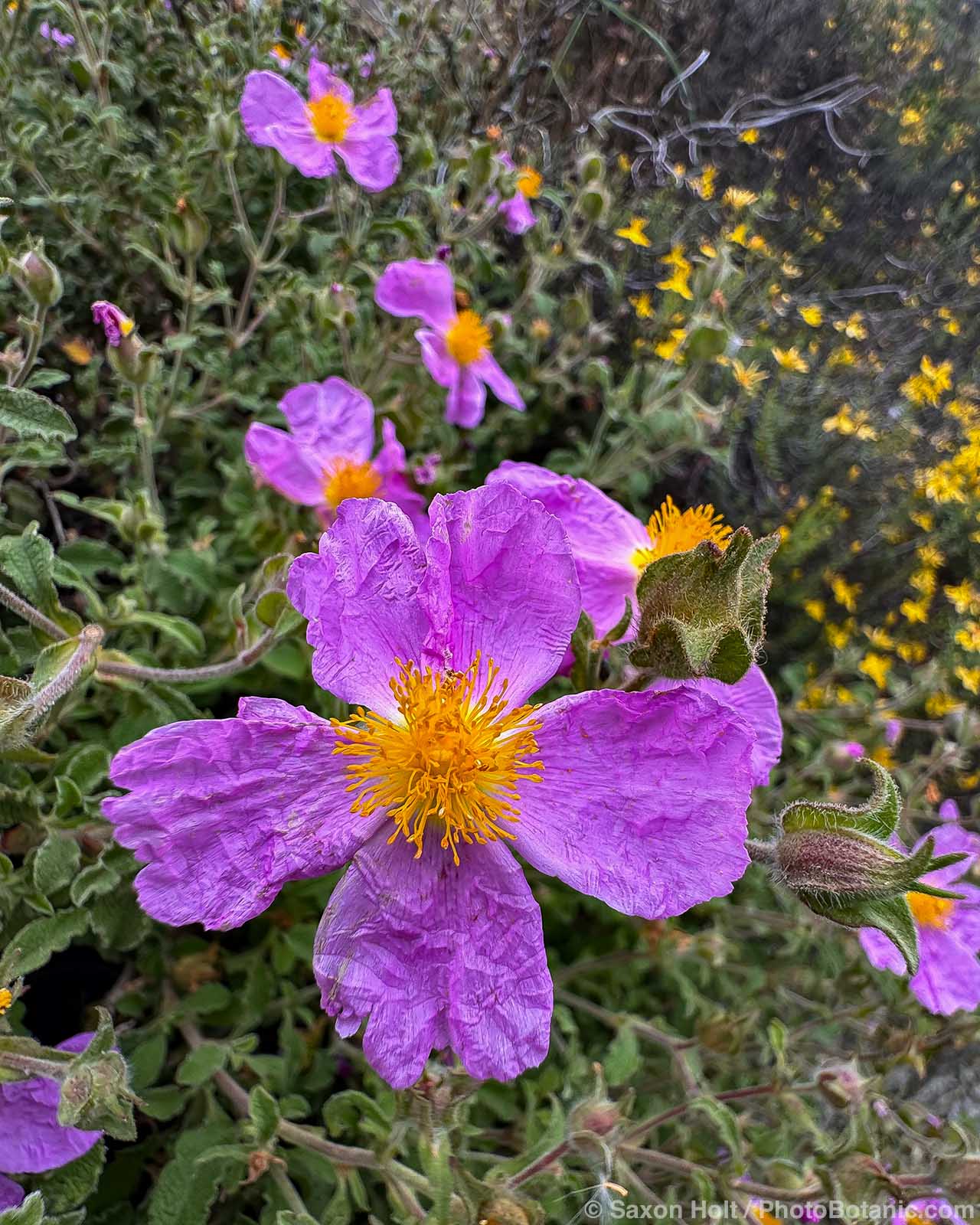
Cistus x purpureus is a nineteenth-century garden hybrid of C. ladanifer and the much lower-growing C. creticus. This is a neat, mounding rockrose 3-5 feet tall and slightly wider. Its narrow, wavy-edged leaves, dark green above and grayish green below, are coated with resin as are those of both of its parents. The purplish pink flowers often have a maroon spot at the base of each petal.
The parent plant Cistus creticus is native to mildly acidic and neutral soils in the central and eastern Mediterranean basin but adapts to most soils as long as they are well drained. This is a fairly upright plant, 2-5 feet tall and 2-3 feet wide with hairy, bluish green leaves and pink flowers. Glandular hairs on leaves and stems produce the sticky resin called labdanum.

Deep red markings on the petals of Cistus x purpureus flowers reveal its C. ladanifer parentage.
Cistus monspeliensis is a mounding groundcover, 3 feet tall and 5 feet wide, sometimes spreading widely by rooting where stems touch the ground. Leaves are narrowly linear, dark green, wrinkled and sticky with resin on the upper surface, softly hairy beneath. Flowers are small and white with yellow stamens. This plant is native to alkaline or mildly acidic soils from Macaronesia and northern Africa through Spain to Turkey and the Aegean islands.
Groundcovers
Although low, mounding plants can be used in multiples to create a groundcovering effect, true groundcovers are low and widely spreading. There are several excellent groundcover rockroses. Some can spread unexpectedly widely.
Cisus x skanbergii is a natural hybrid between C. monspeliensis and C. parviflorus native to parts of Greece and Sicily and originally collected on the island of Lampedusa. Now considered extinct in the wild, it is 2-3 feet tall and 4-6 feet wide with small, pale pink flowers and gray-green leaves. Leaves, stems, and flower buds are softly hairy and not sticky. The parent plant C. parviflorus is about 3 feet tall and wide with small pink flowers and gray-green leaves that are hairy on both sides. It is native to alkaline soils in Greece, western Turkey, Libya, and the eastern Aegean islands.

Cistus salviifolius, here shown in the wild in Greece, is native throughout the Mediterranean basin, including parts of Syria, Jordan, Lebanon, Israel, and Palestine.
Cistus salviifolius is 1-3 feet tall and 4-6 feet wide, spreading more widely by rooting where stems are in contact with the ground. This adaptable rockrose is native to sandy and rocky soils ranging from mildly acidic to mildly alkaline in a wide range of habitats throughout the entire Mediterranean basin. It often grows in the understory of pines and oaks, so it tolerates light shade and root competition. Flowers are white and leaves are wavy-edged, grayish green, rounded and rough but not sticky. ‘Prostratus’ is a lower-growing, more widely spreading selection, 1-2 feet tall and 6-8 feet wide, sometimes much wider.
Cistus x pulverulentus is a natural hybrid between C. albidus and C. crispus found where the two species occur together in rocky, alkaline soils from Portugal and Spain to southern France. The hybrid is available today almost exclusively as the cultivar ‘Sunset’, selected and named in 1929. ‘Sunset’ is a dense, low-mounding, long-blooming groundcover 2-3 feet tall and 6-8 feet wide with softly hairy, gray-green leaves and magenta flowers.

Cistus x hybridus Little Miss Sunshine (right, foreground) has mid-green leaves with yellow margins.
Cistus x hybridus (C. x corbariensis) is a densely foliaged shrub 3-4 feet tall and 5-8 feet wide with rough and wrinkled, dark gray-green leaves with wavy margins and white flowers from red buds. A variable plant, it could be considered mounding but can spread 10-12 feet wide. This is a natural hybrid of C. salviifolius and C. populifolius native to the Corbieres mountains of southeastern France. Said to be one of the hardiest rockroses, C. x hybridus also adapts to a wide variety of soils, including well-drained clay. The cultivar ‘Dunnecis’, marketed under the trade name Little Miss Sunshine, has variegated leaves.
Are Rockroses Invasive? Are They Firesafe?
For those new to Cistus, who may have heard that rockroses are invasive and either fire hazards or “firesafe,” it should be mentioned that, as with almost any plant, there are no simple answers.
Are rockroses invasive? No Cistus species or hybrids appear on national or regional lists of invasive plants. However, any plant so well adapted to mild-winter, summer-dry climates, and especially one that resprouts or regenerates quickly from seed after fire, is going to be watched for its tendency to naturalize in similar climates elsewhere. Add to this an ability to thrive in dry, nutrient-deficient soils and you have a recipe for at least localized garden escapes.
The potential for spread tends to be greatest for species and much less for interspecific natural hybrids and hybrid cultivars. While Cistus ladanifer seeds heavily and can become an aggressive spreader under the right conditions, the hybrid cultivar C. x ladanifer ‘Blanche’ is sterile. Natural crosses and hybrid cultivars generally set fewer viable seeds. Well-known hybrids such as C. x skanbergii, C. x hybridus, and C. x pulverulentus ‘Sunset’ are low seeders and well behaved in the garden.

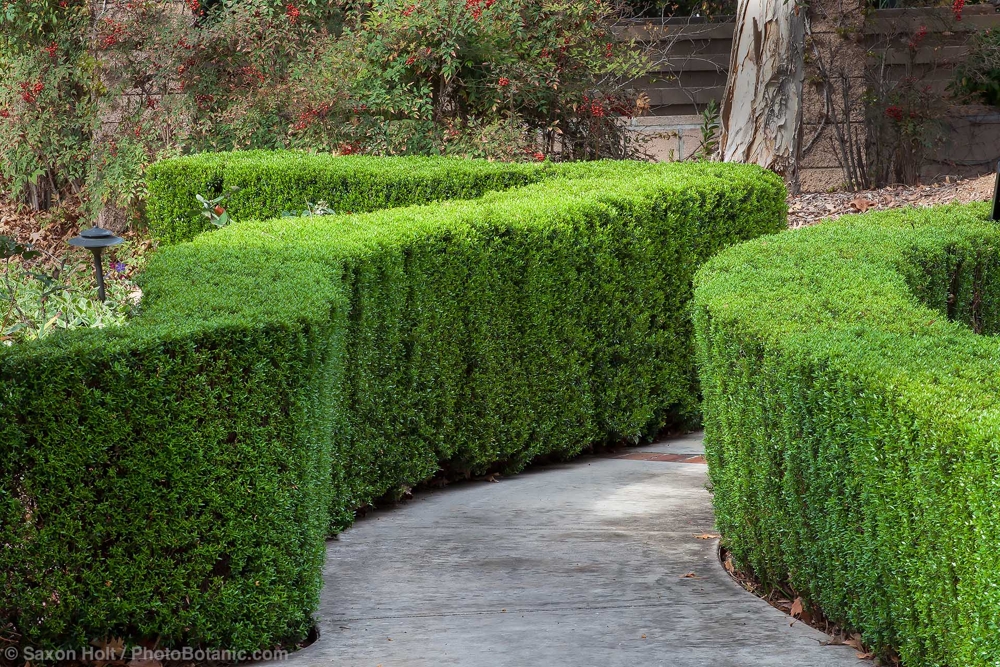
A white-flowered Cistus is glimpsed through an opening in a tall hedge at Digging Dog Nursery in Albion, California.
Are rockroses firesafe? Despite decades of research and wildfire experience, we are still learning how much we don’t know about fire-prone and fire-resistant plants. Cistus species and hybrids have appeared on lists of both fire-resistant and fire-prone plants in the past and even today the popular garden press describes some lower-growing rockroses as fire-resistant or as “often planted in fire-prone areas.”
The reputation of rockroses as fire-resistant may have resulted from research that sought to identify plants suitable for erosion control in areas prone to wildfire. One such study in southern California in the 1970s found low-growing Cistus species to be worth recommending primarily because they thrive in unirrigated wildland plantings where other plants fail.
Also contributing to the firesafe reputation of Cistus may be conflation of the terms fire-adapted and fire-resistant. Cistus species are adapted to fire by their fast growth and ability to reestablish themselves after wildfires. Their resistance to fire likely varies by species with plant height, foliage density, and amounts and kinds of essential oils and resins present in and on the surface of leaves and stems.
The most fire-resistant Cistus probably are those that are low-growing and produce no resin or not enough resin to make the surface of their leaves feel sticky. It’s safe to say that no plants of any kind should be sited adjacent to structures.
For more information on Cistus species and cultivars, see https://cistuspage.org.uk/

Share This!
Related Articles

By: Nora Harlow

By: Saxon Holt

By: Saxon Holt