

Pittosporums

Share This!
Pittosporums are a large group of tough and adaptable evergreen shrubs or smallish trees native to subtropical and tropical Australasia, Africa, and Asia and grown in warm temperate climates throughout the world. Most are fairly fast growing in full sun to part shade in any reasonably fertile soil with decent drainage and little to moderate moisture. All bear small, fragrant, late spring or summer flowers in clusters at the ends of stems followed by conspicuous fruits with bright orange seeds. Several species and quite a few cultivars are commonly found in the nursery trade.
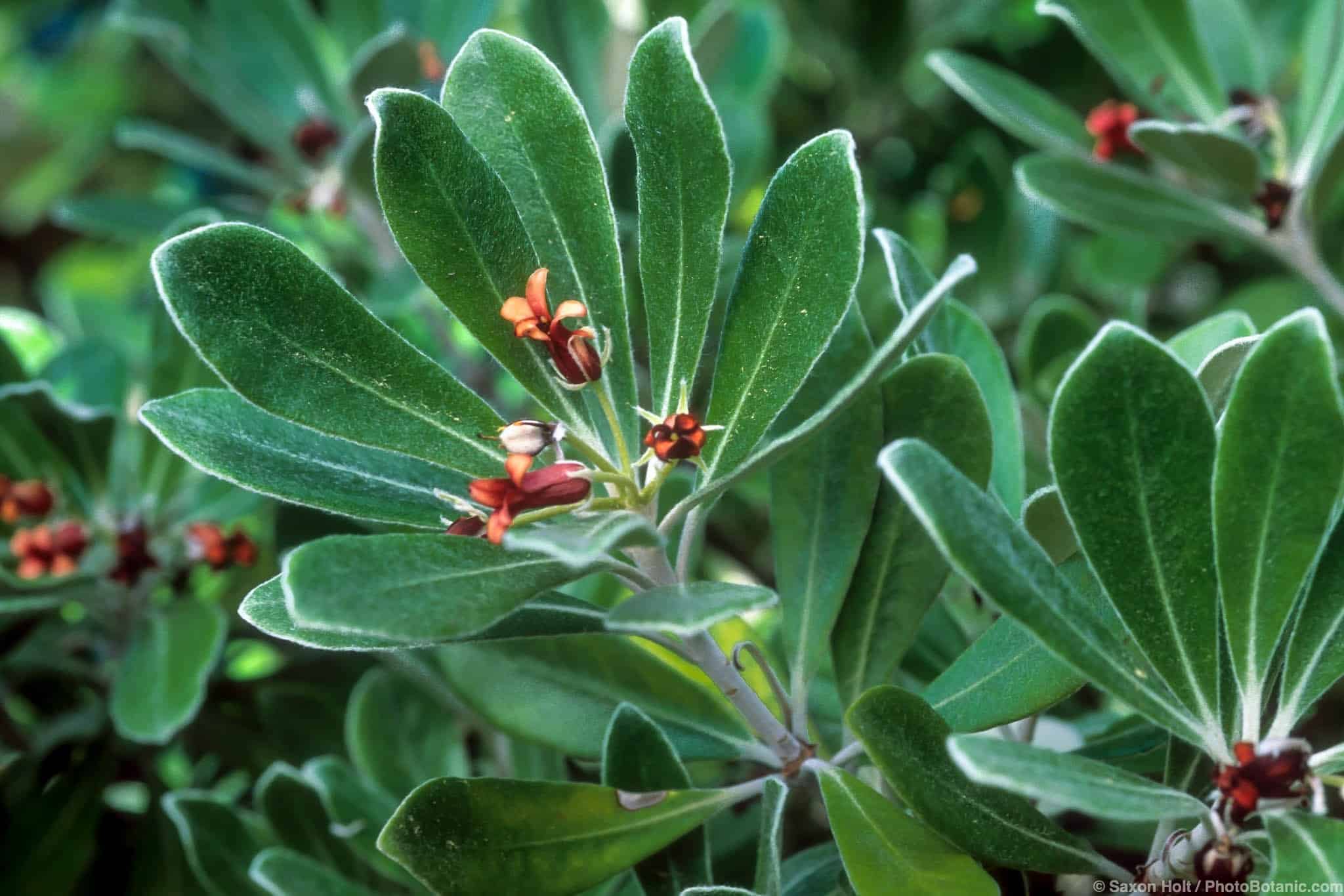
Pittosporum crassifolium leaves and flowers
Pittosporum tobira is a rounded shrub to 15 feet tall and ten feet wide with leathery, dark green leaves, shiny on the uppersides and slightly turned under along the edges. The small, intensely fragrant flowers open white and soon turn creamy yellow. Native to Japan, Korea, and parts of China, this densely foliaged plant makes a fine hedge or privacy screen and is attractive with lower branches pruned up as a small specimen tree. The cultivar ‘Wheeler’s Dwarf’ is two to three feet tall and four to five feet wide. ‘Variegata’, three to five feet tall and wide, has variegated leaves.
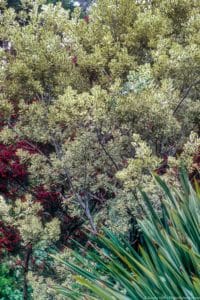
Pittosporum crassifolium ‘Variegatum’
Pittosporum tenuifolium, 25 to 30 feet tall and 15 to 20 feet wide, bears glossy, medium green, slightly wavy leaves on distinctive nearly black stems that accentuate the upright form of this attractive shrub. The flowers are dark reddish purple. Native to New Zealand, it is tolerant of salt spray, dry soils, and shade. Many cultivars are in the trade, including ‘Golf Ball’, an amusingly rounded shrub three to four feet tall and wide with exceptionally dense foliage, and ‘Marjorie Channon’, eight feet tall and wide with creamy white margins on the leaves.
Pittosporum eugenioides is a shrubby tree to 30 feet tall and 15 to 20 feet wide with wavy-edged, glossy green leaves and yellow flowers. Native to New Zealand, it makes a good, fairly fast-growing screen. It needs part shade away from the coast.
Pittosporum phillyraeoides, slow growing to 20 feet tall and 15 feet wide, has narrow, dark green, willow-like leaves and a weeping habit. Native to coastal northwestern Australia, it is tolerant of considerable heat and dryness.
Attesting to the wide adaptability of most plants in the genus, at least two pittosporums have become weedy pests in Australia, while others occasionally have been described as “garden thugs.” All probably should be watched for any inclination to take over or escape. The worst offender is Pittosporum undulatum, commonly known as Victorian box, which is highly invasive in Australia and South Africa. P. crassifolium, an attractive gray-leaved shrub with maroon flowers and several named cultivars in the trade, has also shown invasive tendencies in Australia.
I should put in a good word for Pittosporum tobira in this regard, three large shrubs of which graced the wooded portion of my lot when I settled here almost forty years ago. Mature then, they are elder statesmen now. They make a fearsome mess in winter with their sticky discarded seeds, but these are loved by birds and not once have I seen new plants appear.

Share This!
6 Comments
Leave A Comment
Related Articles

By: Nora Harlow

By: Saxon Holt


Pittisporum are some of my favorite plants. I learned about them in the 70’s while working in a retail nursery in the Bay Area.
Hi Ken,
Yes, as a group pittosporums are attractive and long-lived and wholly undemanding. I hope they do not become invasive in California!
Nora
I have noticed that they tend to stay where they live.
Unlike Oak and pines.
Forgot to add:
Or eucalyptus.
Absolutely loved this insightful post on Pittosporums! Your detailed breakdown of their versatility in landscaping has inspired me to incorporate them into my garden plans. I can’t wait to visit my local nursery to pick out the perfect Pittosporum for my space!
Thanks for your comments Nova, my tobiras are still going strong at well over 60 years old!
Nora