March 2026 Newsletter: Wildflower Season

Share This!
Greetings, friends –
Writing a monthly newsletter for all of you across our wide region and incredibly diverse summer-dry climates is an exercise in humility. We wrote last month saying it might be time to water the garden because it had been so dry all of January and early February. By the time the newsletter was delivered, the weather had changed. A friendly reader wrote to say it was flooding in their town the very day they got the newsletter.
And now we are going to try to predict the wildflower season. Your region may vary. However, with all those good rains, it should be an excellent and lingering wildflower season. In some desert areas, the peak may have passed because of the early winter rains, but do not for a second believe that you have missed this special season.
This advice holds true no matter where you are in the world of summer-dry climates. Down under in Western Australia, in Chilé, and in the Cape of South Africa, it has probably been a hot summer, and it may be hard to imagine spring. But spring will come, wildflower season will return, and you can make plans then to go out. One never regrets going out and finding inspiration for the garden in the spring.
In the event of a super bloom, it is always the wildflowers that get the most attention, but gardeners should pay more attention to the shrubs and perennials, which often flower weeks after the buzz of a flower extravaganza. In the design tips below, note the photos were taken in late March, 2017 in Anza Borrego State Park–several weeks after the annual wildflower peak. We wanted to see the perennials and the shrubs at their best to get some practical ideas for our gardens. As much as we all love wildflowers, they are herbaceous annuals and ephemeral. Go out and look for the more durable native woody plants.
And as a practical garden tip – most of the weeds in the garden are annuals too. March is still a good time to get them before the roots get too deep and difficult to dig.
~ Saxon Holt and Nora Harlow
March Blog Post: Stachys byzantina

Imagine the excitement that might ensue if Stachys byzantina were a recent introduction to horticulture instead of a centuries-old staple of gardens almost everywhere. Commonly known as woolly lamb’s ear, S. byzantina is an attractive, useful, easygoing plant that readily accepts the supporting roles of defining spaces, covering bare ground, and serving as a foil for flashier garden elements.
Read On
Instagram Memories
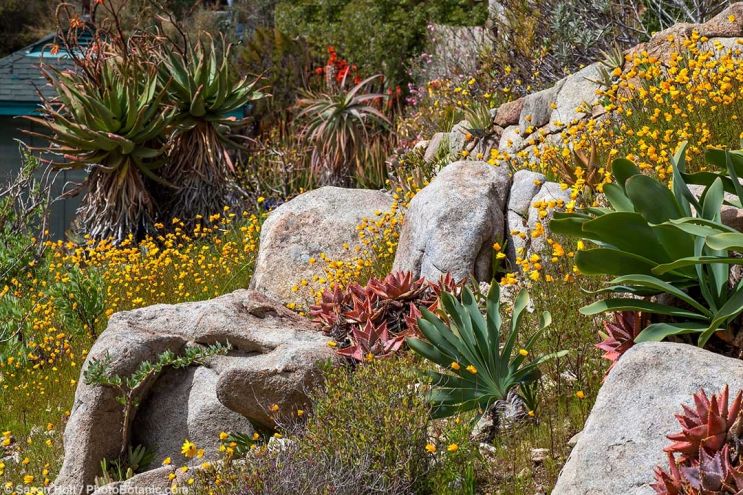
March 16, 2021
“Ursinia cakifolia, flowering annual wildflower among Aloes and rocks in South African section of University of California Botanical Garden at Berkeley.”
Follow Us on Instagram
A Trip to a Desert garden
Gardeners imagine plant combinations we see in nature with an entirely different understanding than an ecologist imagines how a native plant found in the wild might work in a garden. Experienced gardeners will see natural combinations in a way that an ordinary outdoor enthusiast might not recognize.
We took several trips to the Sonoran desert in Anza Borrego California State Park during the superbloom year of 2017 and wrote A Real Desert Garden for PhotoBotanic where these photos first appeared.

Nature’s garden in the Sonoran Desert at Anza Borrego California State Park – gully with natural gravel path and Yellow flowering brittlebush (Encelia farinose) and Chuparosa (Justicia californica) among rock outcrops.
Many of us were inspired by nature and a love of plants to have our own gardens, and now that we have surrounded ourselves with plants, it is particularly thrilling to go back to nature and see what we might not have recognized. Even if our plant palette has expanded beyond natives, seeing natural communities gives us clues of how plants like to live together.

Ocotillo cactus (Fouquieria splendens) frames a flowering Creosote Bush (Larrea tridentata) with Brittlebush (Encelia farinosa) in foreground. Note plant echoes.
Native plant communities evolved in harmony that gardeners see, especially after we have worked with plant combinations ourselves. And our own garden plant communities will evolve as we notice how textures and shapes, colors, foliage, and flowers combine in nature.

Nature’s shrub border, white flowering Bushmint (Condea emoryi), red Chuparosa (Beloperone californica), yellow Brittlebush (Encelia farinosa) and evergreen shrub – Creosote Bush (Larrea tridentata).
All these examples are from one desert plant community, especially easy to see when it is in bloom. Every plant community has its own beauty and it’s own time. Don’t miss them this spring.
Get More Ideas in our Book
Links We Like
There are numerous Facebook wildflower groups in every state, and California State Parks has an interactive map.
We would love to hear about any resources you would like to pass along. We all get these snippets from our news feeds and inboxes. Let’s share the best, and we will keep the running list so you can find them later on the Links We Like page.

Share This!
Related Articles

By: Nora Harlow

By: Saxon Holt

By: Nora Harlow