Solidagos That Stay Put

Share This!
Anyone who has inadvertently planted a fast-spreading goldenrod can be forgiven for a painfully acquired reluctance to consider another Solidago. But there are good reasons for planting solidagos. In addition to the late-summer color their long-blooming golden yellow flowers provide, these are keystone plants where they are native, central to the health of local ecosystems.
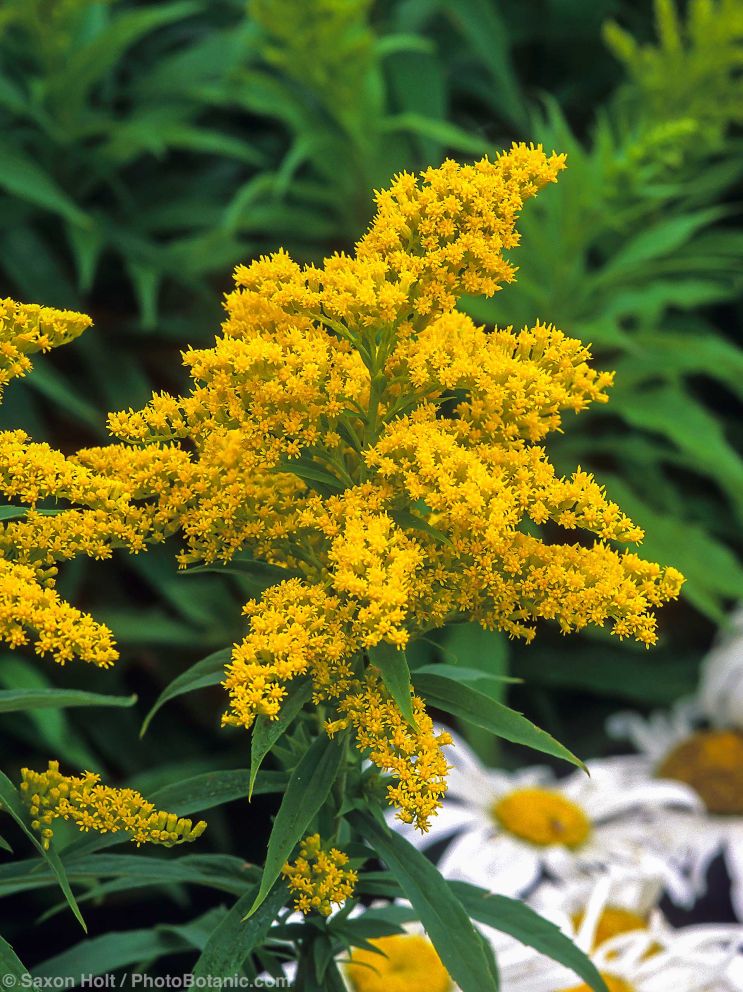
Solidago canadensis, native to much of North America, is famous for its aggressive spread.
In nature the substantial size, vigor, and rapid spread of many solidagos are beneficial – attracting and sustaining an enormous variety of pollinators and other insects that then are food for other wildlife, most notably migrating birds and butterflies and the offspring of nesting birds. Solidagos also offer protective cover and shelter for overwintering native bees and small wildlife. They stabilize soil, improve soil health, and moderate temperature and wind near the ground. Some can even outcompete and help to control invasive exotics.
Solidagos offer some of the same benefits in the cultivated landscape, but their tendency to dominate can overwhelm other plants and wreak havoc on the garden’s intended design. Fortunately, there are alternatives.

Solidago spathulata is a well-behaved native alternative to the fast-spreading S. velutina ssp. californica in northern California.
Of more than 100 species of Solidago at least 80 are native to North America in environments ranging from coastal dunes to alpine meadows to desert washes and from dry, rocky slopes to bogs and marshes. Most of these are native to eastern North America. Western North America has fewer native solidagos but some are distributed widely.
All solidagos are winter-dormant, late-summer to fall blooming, herbaceous perennials from less than a foot to six feet tall. All bear dense, spikelike, flat-topped, rounded, or one-sided clusters of tiny, usually bright yellow, disc-and-ray flowers typical of the daisy family. Especially in gallon cans, plants in bloom can look deceptively similar.

Solidago odora, native to eastern North America, grows from a branching caudex and does not spread aggressively.
For gardeners the differences among Solidago species can be highly significant, as many of us have discovered. In simple terms, there are clumpers and spreaders, the latter often spreading aggressively by rhizomes and sometimes forming extensive colonies. Clumpers generally develop as a slowly expanding cluster of stems from a woody root crown or caudex just above or below the surface of the soil.
The dichotomy is not a perfect predictor of aggressive spreading. Some species, such as Solidago spectabilis, have both caudex and rhizomes and, though generally well-behaved clumpers, may spread by rhizomes under the right conditions. Others, such as S. rigida and S. speciosa, are clumpers that sometimes spread vigorously by seed.

Solidago spectabilis, native to wet or seasonally wet seeps and washes in North America’s arid Great Basin, is usually well-behaved but can spread under optimal conditions.
Some of the best solidagos for gardens are compact clumping plants that spread slowly if at all. Solidago spathulata, 1-2 feet tall, is a clumping or mat-forming plant native to sand dunes and coastal scrub along the coast of central and northern California and Oregon. S. multiradiata is similar but native to the mountains of western and northern Canada south into the Rocky Mountains and the Sierra. S. odora, 2-4 feet tall and 1-2 feet wide, is native to dry, open woods and pine barrens along the east coast west to Ohio and south to Texas. A clumper, it can spread slowly by short rhizomes and by seed.

Solidago ‘Fireworks’ is a clumping selection of the faster spreading S. rugosa, here planted as a groundcover.
Several good solidagos for gardens are better-behaved selections of species that tend to spread faster and more widely. ‘Fireworks’ is 3-4 feet tall and 2-4 feet wide and tends to form a slowly expanding clump. The species, Solidago rugosa, is native throughout eastern, southeastern, and midwestern North America and spreads widely by rhizomes in a variety of moist to wet environments. ‘Cascade Creek’ is a slowly spreading selection of S. velutina ssp. californica, which spreads vigorously by rhizomes.
Other good candidates for the garden are ‘Wichita Mountains’, species unknown but believed to be a selection of Solidago petiolaris, and ‘Solar Cascade’, a selection of S. shortii. ‘Solar Cascade’ is 2-3 feet tall and 3-4 feet wide with flowers at the ends of arching stems. The species is rare and endangered, now restricted to a few populations in dry, rocky areas in Indiana and Kentucky.
‘Wichita Mountains’ is about the same size but with flowers at the ends of upright stems. The presumed species is larger, to five feet tall, and native to sandy or rocky soils in southeastern and south-central United States into northern Mexico.

Painted lady butterflies feast on the nectar of Solidago ‘Wichita Mountains’.
Of course, if you are planting solidagos to support your local ecosystem, it is best to plant a local native. Aggressive species are widely available in the trade, so be sure to do your research before heading to the nursery or ordering online.
All solidagos will attract and feed pollinators, but butterflies can be fussy about the plants on which they will lay their eggs and many native bees will take pollen only from particular natives to feed their young. No butterfly eggs, no caterpillars. No caterpillars, no nesting birds. No native plants, no sustained populations of native pollinators and the ecosystems that depend on them.

Share This!
Related Articles

By: Nora Harlow

By: Saxon Holt

By: Nora Harlow