Stachys byzantina
Share This!
Imagine the excitement that might ensue if Stachys byzantina were a recent introduction to horticulture instead of a centuries-old staple of gardens almost everywhere. Commonly known as woolly lamb’s ear, S. byzantina is an attractive, useful, easygoing plant that readily accepts the supporting roles of defining spaces, covering bare ground, and serving as a foil for flashier garden elements. It is less often appreciated for its own textural and architectural contributions to landscape designs.

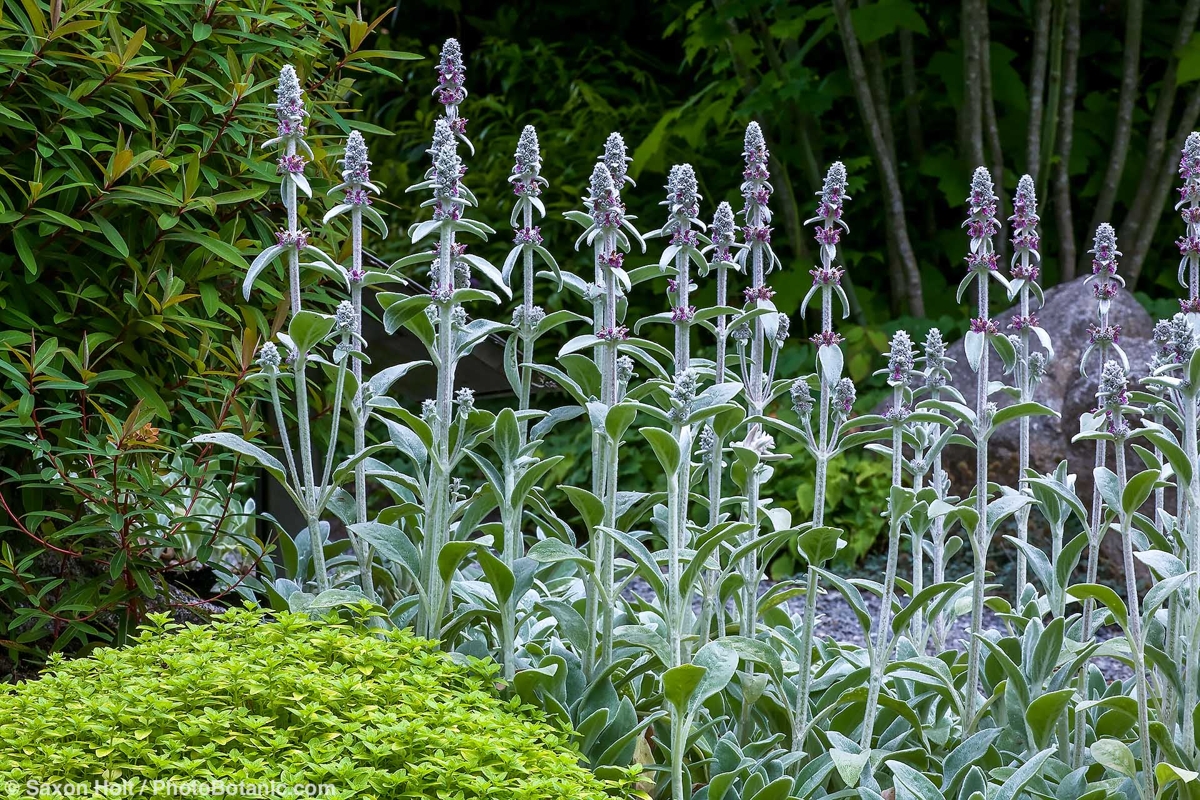
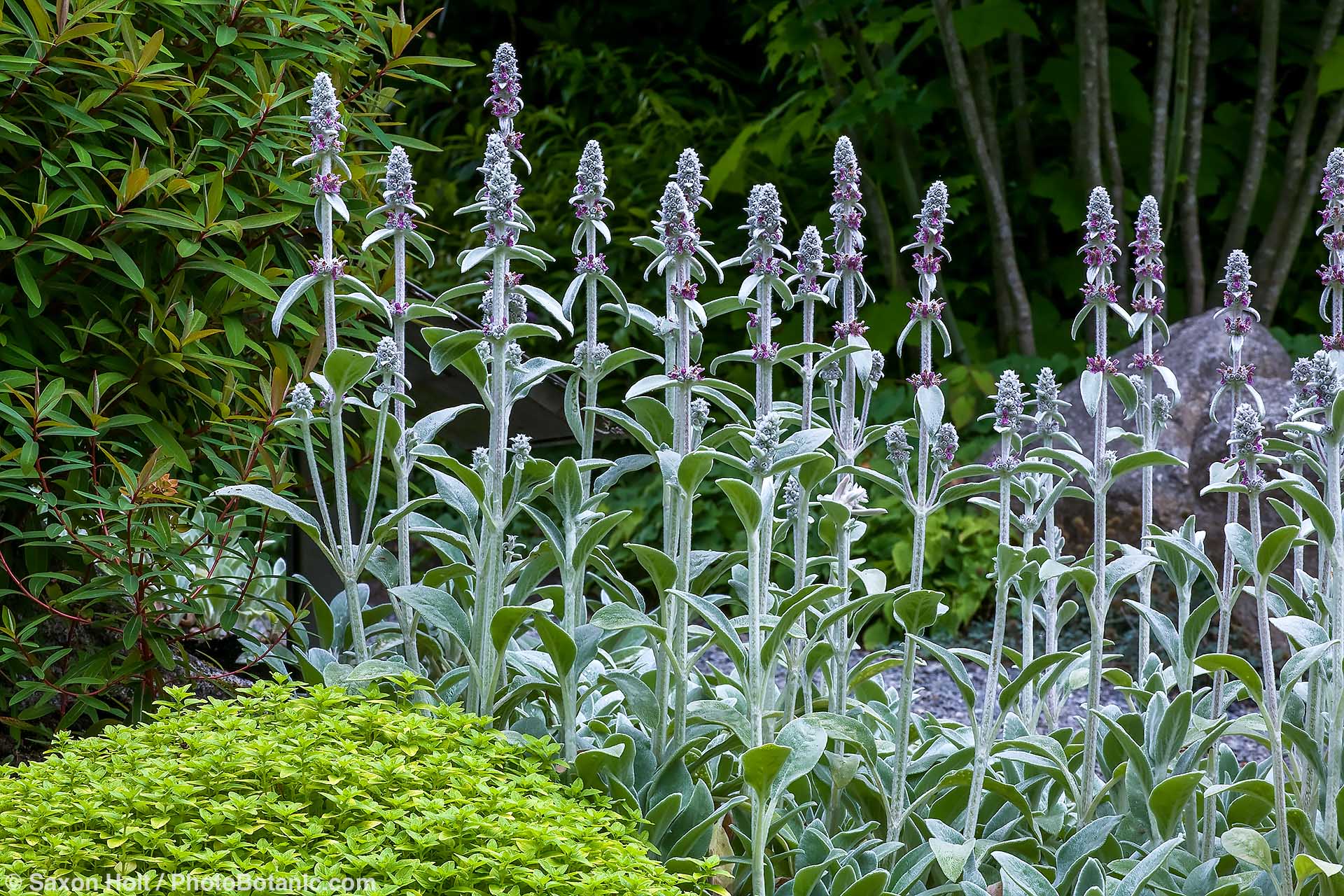
Boldly upright flowering stems of Stachys byzantina add structural interest and punchy color contrast to garden vignettes.
Stachys byzantina is native to semi-arid, summer-dry mountains of western Asia from northeastern Turkey through Armenia and Azerbaijan to northern Iran. In these regions soils are rocky and fast-draining. Winters can be cold, but summer temperatures are milder than at lower elevations nearby. In gardens, S. byzantina thrives in similar conditions: sharp drainage, good air circulation, and many hours of full sun with some protection from the hottest afternoon temperatures.

Well grown, Stachys byzantina is supremely neat and orderly, lending itself to formal landscape designs. Shown here is the cultivar ‘Helen von Stein’.
Valued as a medicinal tea and an antimicrobial wound dressing, Stachys byzantina was harvested wild and cultivated in its native lands long before it was introduced to Europe as a garden ornamental. By the late 1770s it was offered in European nursery catalogs as a recently imported ornamental plant from Turkey. In both Europe and North America it came to be widely used as edging in the disciplined designs of nineteenth-century Victorian garden beds and borders.

Stachys byzantina ‘Big Ears’ (foreground) defines the space and sets off both the pot and the plants behind it.
Today Stachys byzantina is still most often used as a space definer, even to the extent that flowering stems are routinely removed to emphasize the horizontal habit of its foliage. Bowing to this widely held preference, breeders have selected cultivars that bloom rarely or not at all. Best known are the large-leaved ‘Helen von Stein’ and ‘Countess von Zeppelin’ (both often marketed as ‘Big Ears’) and ‘Silver Carpet’, which has smaller leaves and few flowers.
The flowers of Stachys byzantina are usually described in catalogs as inconspicuous, but they are hardly inconsequential. The purplish pink to lavender, late-spring to midsummer flowers are tiny, but they are borne in dense whorls on silvery gray, woolly stems and surrounded by equally woolly, leaflike calyces that are decorative in their own right. On some plants the flowering stems can rise two feet above the tightly packed rosettes of silvery gray-green, woolly leaves. The texture alone is striking.

Flowering stems add texture and color to a California meadow garden.
It is widely believed that flowers of Stachys byzantina should be removed because plants decline after flowering. In my northern California garden even non-flowering plants decline after a soggy, wet winter, but they quickly revive with the warming days of spring. These are vigorous plants, both fast-spreading by rooting stems and fast to produce new rosettes that soon rise above the damaged old leaves.

Similar colors of Stachys byzantina and Ephedra equisetina accentuate their contrasting textures.
If you are inclined to remove the flowering stems –for the health of the plant or for aesthetic reasons— consider removing them just before they go to seed. This will negate their tendency to seed about while retaining the benefits of flowers much loved by bees, butterflies, and other pollinators.
For maximum flowers you may need to track down a source of Stachys byzantina species instead of one or another of the non-flowering or low-flowering cultivars. While some cultivars do form flowers, the most prolific floral displays are likely to come from the species.
You can, of course, grow your own plants from seed. Seeds should be surface sown, just lightly pressed into the soil but not covered. Germination takes about three to four weeks. Seeds are widely available online.

Share This!
Related Articles

By: web@thegardenofwords.com

By: Saxon Holt

By: Saxon Holt