

Oleander
Share This!
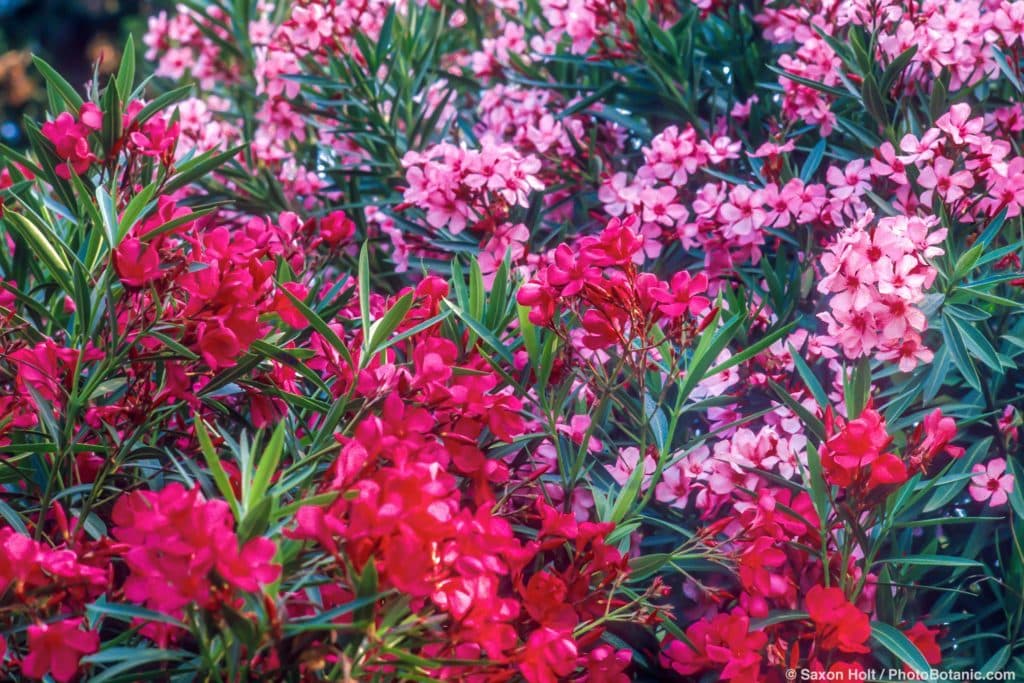
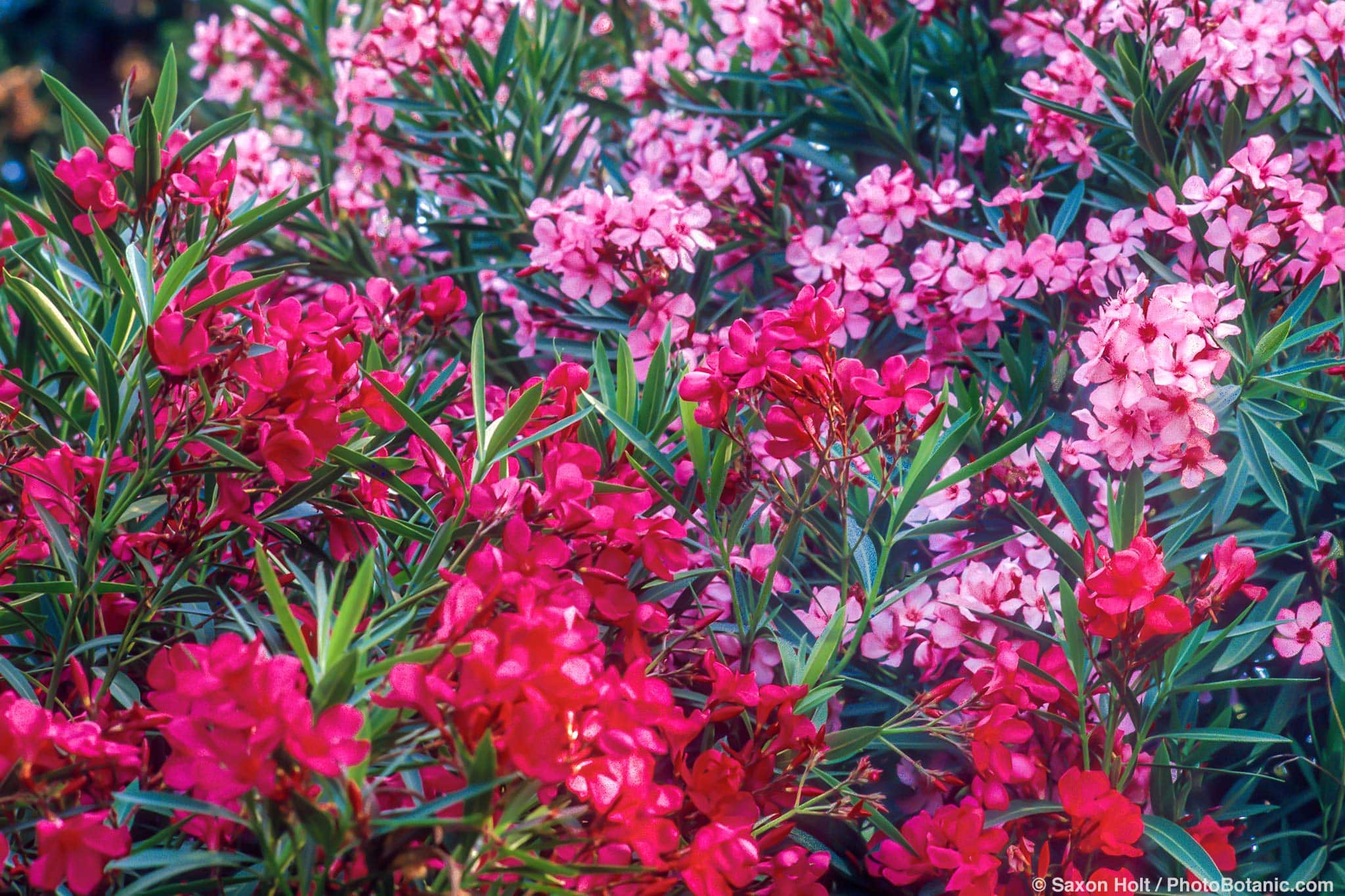
Nerium oleander
Every so often it is worth reconsidering a once wildly popular plant that, apparently for no reason other than overexposure, has fallen completely out of favor. Agapanthus is one of those plants. Oleander (Nerium oleander) is certainly another.
Overplanted in housing developments and along freeways in the 1960s and ‘70s, oleanders now seem to be seldom planted except by those who appreciate the dense screening provided by their lush evergreen foliage, their lengthy period of exuberant flowering, and their robust constitution.
Oleanders are astonishingly tolerant of drought, reflected heat, wind, salt spray, poor soil, neglect, severe pruning, and almost every other insult that can be directed their way. Other than full sun and occasional summer water until fully established (which can be five years or more), oleanders seem to have few requirements. One thing they cannot stand is prolonged freezing, although even from that they may quickly recover.
Forty years ago I planted oleanders in gardens I made for others. Twenty-five years ago I planted them in my own garden as a screen between me and my neighbors. A dozen years ago I cut them to the ground and authorized their destruction by backhoe during a major garden renovation. They sprang up again and are still thriving. Faced with such determination, who am I to say they cannot remain?
Native to or naturalized in warm temperate and subtropical areas from southern Europe and north Africa east to southwest Asia, oleanders are upright woody shrubs eight to ten feet tall and wide, although there are dwarf cultivars half that size and others that reach heights of eighteen to twenty feet. All have long, narrow, lance-shaped leaves and funnel-shaped flowers in showy clusters at the ends of branches. Flowers are pink, red, white, salmon, or yellow and some are lightly scented though, lacking nectar, they are not noticeably attractive to bees and butterflies.

Share This!
12 Comments
Leave A Comment
Related Articles

By: Nora Harlow

By: web@thegardenofwords.com

By: Nora Harlow

They are no longer suitable in southern California where the slow march of progress has brought us an oleander leaf scorch disease that is ultimately fatal.
I don’t mind one bit. As you point out, the plant is tediously ubiquitous in tract landscaping, along freeways, and (prior to widespread disease) big box home improvement centers.
Thanks for this update Brent.
Hi Brent,
Ubiquitous, yes, tedious, maybe, but where oleanders are not affected by various bacterial and viral diseases, they really do have some very fine qualities. Here in California we are jaded, I think, from decades of overexposure.
Nora
You may want to learn more about Xyllela fastidiosa and the wide range of plants that are susceptible. Oleanders got the nix because of their host capacity for the glassy winged sharp shooter. Google Pierce’s disease on grapes, see what’s happening to Olives and Liquidambars. there’s a reason this plant (Oleander) has lost favor.
you don’t need to reply or even post my response, just check it out yourself.
I like that Van Gogh thought them pretty enough to pick bouquets of them, putting them into a majolica vase to paint. http://www.metmuseum.org/art/collection/search/436530
Wow ! Thank You Laurie. I am a big Van Gogh ann an never need he painted Oleander. From your link:
For Van Gogh, oleanders were joyous, life-affirming flowers that bloomed “inexhaustibly” and were always “putting out strong new shoots.”
Hi Laurie,
I have to admit that I also put the flowers in vases, where, though rather floppy, they are long-lasting and gorgeous!
Nora
As a colorful barrier against deer there is no better. In the right place ( background with plenty of space) I have not so much see leaf scorch but sooty mold left over after an aphid infestation that just looks horrible. I have started putting them in some gardens I design where appropriate especially in areas where deer grazing is a problem – it is one of the few plants that I have seen deter deer.
Carol – The are indeed deer proof as they are poisonous. Be careful of putting then anywhere that livestock might graze.
Hi Carol,
I should have mentioned their absolute protection against deer, for that is why I originally planted them! Deer simply do not touch oleander.
Nora
Overused and poorly-used, yes. But worthy of certain applications, to be sure. Here, no leaf scorch so far, and people treat like perennials they pack in too close and severely cut back each year…and they like that, too.
David, you are right! Many of the problems with oleanders have to do with poorly thought out applications. This plant is wonderful where appropriately used, though I do understand why so many people these days avoid it, perhaps because of its overuse in the past in our part of the world. I’m expecting oleanders to come back in fashion some day (as so many good but overused plants have).