Fire Zone Landscape Codes

Share This!
Following years of devastating fires, in 2020 California modified its wildfire defensible space law by passing Assembly Bill 3074. This is when we first heard the term Zone Zero, the 5-foot zone immediately next to a house that is supposed to be free of any flammable materials, including vegetation.
Almost every gardener I know began to panic. Garden design has long used foundation plantings as a way to hide houses, provide privacy, decorate our entries, and showcase our most prized plants. Many of us have already run out of gardening space and have way more plants than property. How the heck are we going to move or remove our long-established lovelies?
Immediately we began to wonder how to push back on the bureaucracy itself, those faceless office-dwelling bureaucrats who wouldn’t know the difference between a habitat garden and a sculpture garden. Surely this initiative was proposed by insurance companies and firefighters who wanted building codes to negotiate the requirements for maintaining defensible space.
Was anyone paying attention to how devastating wildfires actually move through neighborhoods? Wasn’t it obvious that houses were catching the vegetation on fire, not the other way around?
Indeed, there is a lot of evidence supporting healthy, hydrated vegetation as a way of slowing the advance of wildfire and even preventing houses from catching fire. A three-block line of Deodar cedar trees (Cedrus deodara) in Altadena seems to have stopped the January 2025 fire from spreading to adjacent homes.

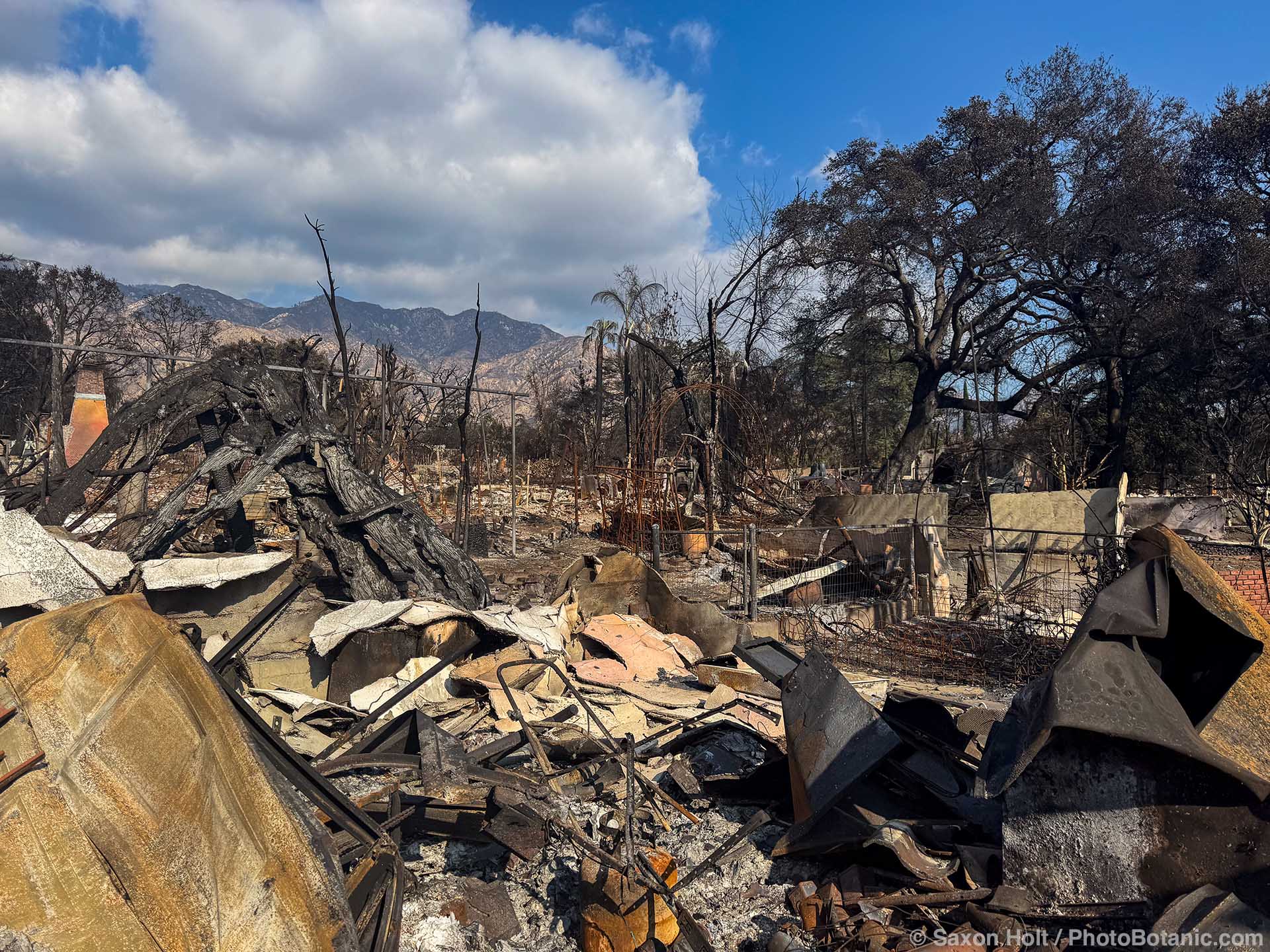
Fire damage on east side of Christmas Tree Lane, Altadena, January, 2025
In the worst firestorms nothing is safe, even glass melts. The new regulations are intended to prevent the big conflagrations from ever starting, to prevent small neighborhood fires from becoming urban catastrophes, to stop one house from exploding into flames and sending embers across town. There is certainly more fire protection to be done with urban planning, home construction, and open space vegetation management, but landscape zoning in fire-prone urban areas should be an important consideration in garden design.

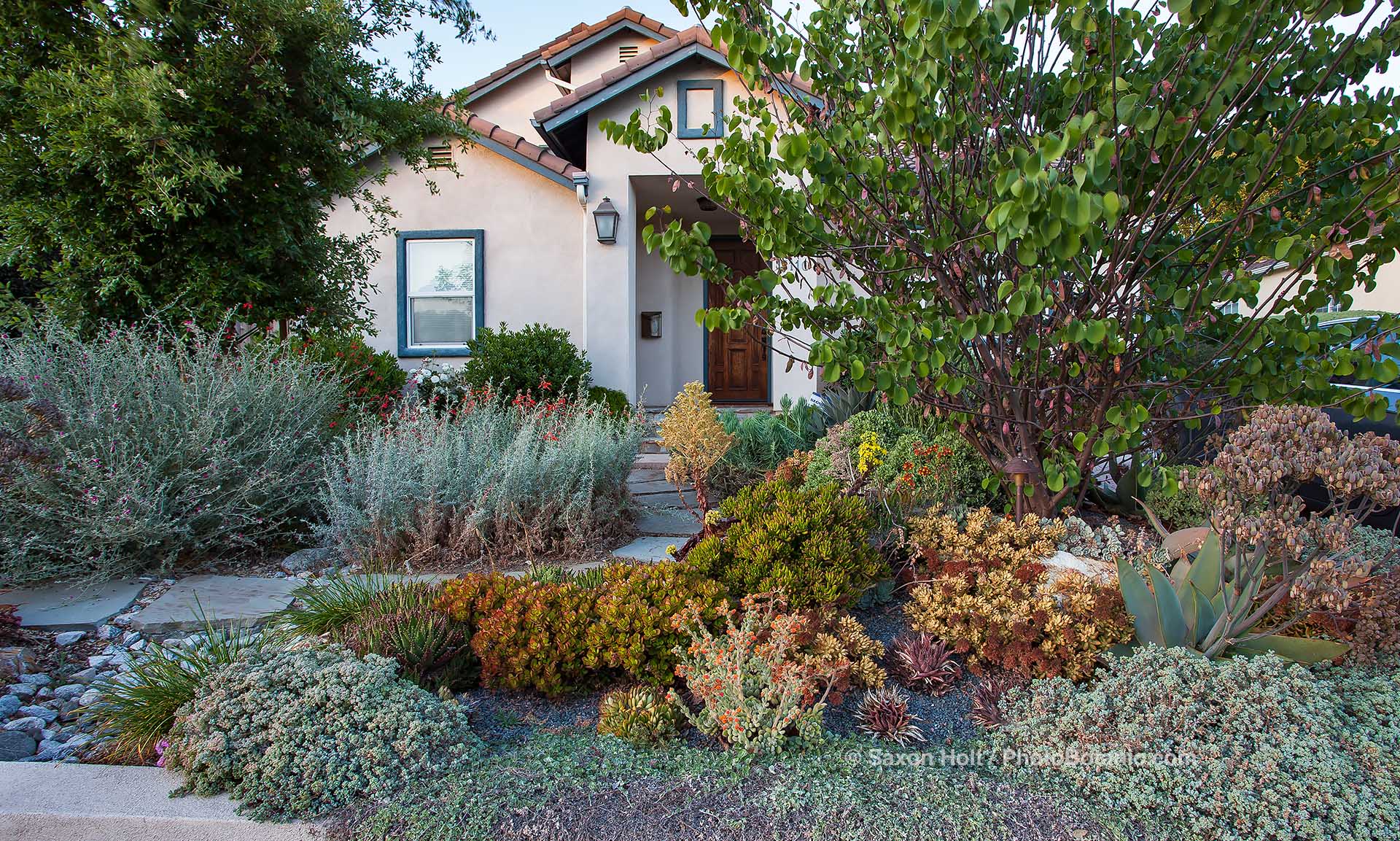
Zone Zero landscape with 5′ wide stone path, April Owens design, Santa Rosa, California
With this in mind I have come to believe in the importance of Zone Zero as the five-foot ember-resistant zone surrounding structures in high-hazard zones. Let’s look at what it actually means now that the recommendations of the California Department of Forestry and Fire Protection, five years in the making, are becoming code. Implementation for new construction will happen as soon as code is adapted (likely Jan 2026) and will apply to existing home landscaping in high hazard zones within 3 years. (see below for hazard calculator).
As I write this in July 2025, the wording is still being adjusted. Only two weeks ago the draft for section 1299.03 paragraph (b) subclause (2) was changed from “No trees are permitted in Zone 0” to “A tree is permitted if it is taller than the adjacent Building or Structure’s roof ridgeline and does not have any dead and dying branches. All live tree branches shall be kept ten feet (10’) above the adjacent Building or Structure’s roof ridgeline.”
The final wording may change again, and the code will apply only to land where the State has financial responsibility for wildland fire protection and prevention (a State Responsibility Area or SRA). Cities and Local Responsibility Areas (LRA) have the right to create their own codes, but often they follow the lead of the State agencies. Insurance companies use their own assessment tools.
The most important factor in figuring out where the code applies is knowing the Fire Hazard Severity Zone (link includes calculator). I live just outside the city limits of Novato in the County of Marin, a SRA district, and was delighted to find that the calculations show my home is in a “Moderate” hazard zone. This means (as of current wording) I will not have to comply with Zone Zero landscaping requirements.
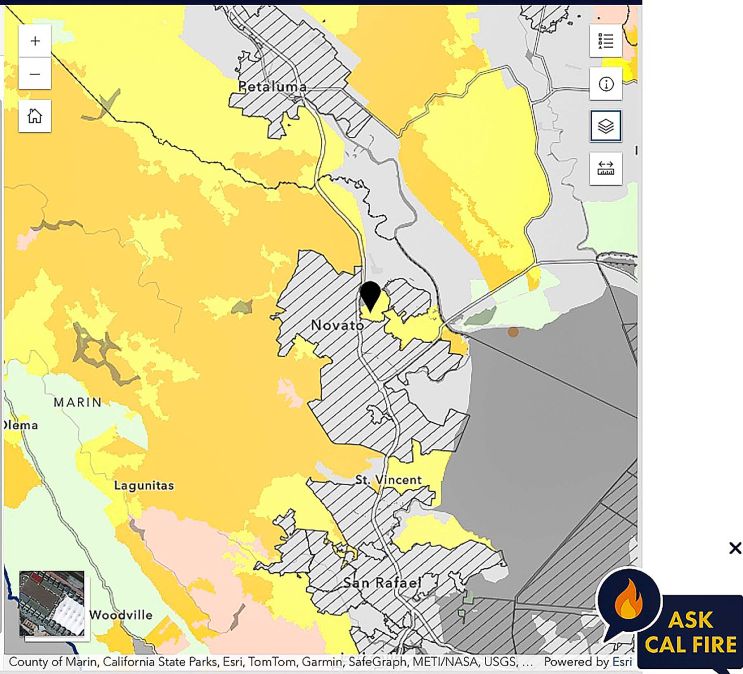
Cal Fire Hazard Severity Zone map for areas around Novato
However, a moderate hazard zone is not necessarily moderate risk and insurance companies use risk assessment differently. I consider myself a high risk (and insurance companies may too) because my house is made with redwood siding, I have a large attached deck, and I am living in a mixed-forest open space in the middle of the Wildland Urban Interface.
For the State of California “hazard” is based on the physical conditions that create a likelihood of wildfire and expected fire behavior over a 30- to 50-year period without considering mitigation measures such as home hardening, recent wildfires, or fuel reduction efforts. “Risk” is the potential damage a fire can do to the area under existing conditions, accounting for modifications such as fuel reduction projects, defensible space design, and ignition-resistant building construction.
Whether or not I must comply or I should comply with the 5-foot setback are two different questions. As a responsible homeowner, I want to do whatever I can to reduce risk, harden my home, take care of vegetation, and look hard at my plant choices.
This is why I think the code is a good thing. It is guidance for homeowners in moderate-hazard zones and policy in high-risk zones. We should encourage (require) homeowners in very high hazard zones to create the 5-foot vegetation setback. Most homeowners are not gardeners and don’t understand maintenance, hydration, and taking care of their vegetation. As much as most of us hate to be told what to do, and hate regulations, some regulations are for the benefit of the larger community. That’s what it is to be a civil society. Our previous article on Planning for Fire.
Cal Fire Clearinghouse Data Center for documents, research, and best practices
Zone Zero FAQ Defensible Space Zones and History

Share This!
Related Articles

By: Nora Harlow

By: Saxon Holt

By: Nora Harlow