February 2025 Newsletter: Planning For Fire
Share This!
Greetings, friends –
The Los Angeles fires are still on our minds. We walked the devastated neighborhoods in Altadena that are piles of abandoned, toxic rubble. Once the wind-whipped fire jumped into those densely packed neighborhoods, firescaping would not have prevented any of the destruction. But some trees survived. Read more below about which plants burn.
~ Saxon Holt and Nora Harlow
February’s Blog Post: Planning for Fire

Summer-dry climates are prone to wildfires. We love our hot, dry summers, which, after wet winters, make the vegetation tinder dry. Fires are inevitable and normal, and to live safely in this climate we have to plan for fire and hydrate our built landscape.
Read More
Instagram Memories

From Jan 11, 2021.
This garden design by Arcadia Studio has a fire-suppressing rock wall weaving between California native oak trees (Quercus agrifolia).
Follow Us on Instagram
Which Plants Burn
All plants burn and in the worst conflagrations it would be misleading and wrong to suggest that better garden design or plant choices would have prevented homes from burning. (But please don’t design your yards with wooden fences connected to the house, they become pathways for fire.) Mostly though, the houses set each other on fire and the vegetation is consumed with it.
But some trees survived, indicating hope for cities in summer-dry climates where long, dry, hot summers keep fire a predictable fear. Good tree choices can help by creating a green infrastructure that slows down fires and actually protects homes. Urban fires are not like forest fires. They are not in the canopy of trees; they mostly run under the trees from house to house. If the fires run into a healthy, hydrated evergreen tree, the embers are slowed.

There are many stories circulating in Altadena of trees that survived. Many native live Oak trees (Quercus agrifolia) like the ones above withstood the fires. In most cases these were well-maintained trees, pruned by homeowners and hydrated by whatever neighborhood gardens their roots could find.
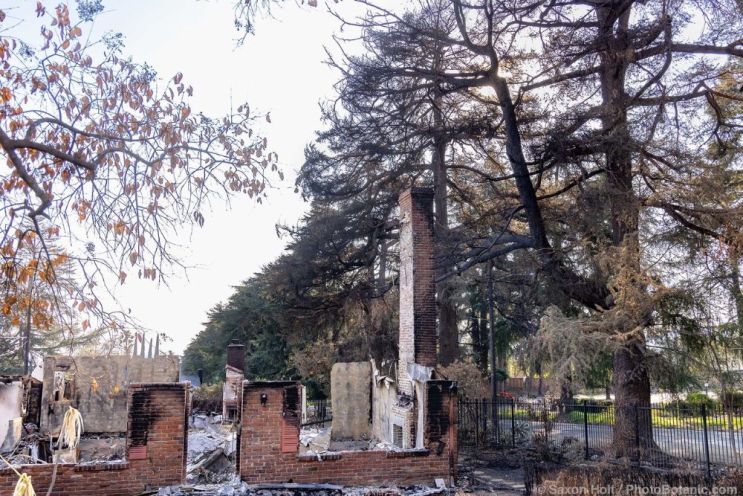
There is also the remarkable story of Christmas Tree Lane, a well-known section of Santa Rosa Avenue that is lined on both sides with 135 deodar cedar (Cedrus deodara). The neighborhood takes pride in these trees and they are green and healthy with branches all the way to the ground.
Look carefully at this photo and you will see two trees singed next to a house that burned, while across the street a house stands untouched amid a green yard. You will see a line of trees marching down the avenue where no more houses burned. This observation is certainly not any proof the trees stopped the fire. The fires jumped over other neighborhoods for reasons nobody knows, but this line of trees does seem the most logical explanation.
Urban planners will be studying these fires for years, looking for ways to make cities more prepared and resilient—before the conflagrations come. We will continue to advocate for a truly green infrastructure and hope gardeners who live in cities will plant evergreen trees, especially in their front yards, and include a rain garden for all the trees in the neighborhood to find.
Get More Ideas in our Book
Links We Like
The Las Pilitas Nursery website has a wealth of great information about California and buried deep in the site under the Nature of California you’ll find leaf burn times, researched and compiled by Bert Wilson. He includes not just native plants but non-natives and even mulches.
We would love to hear about any resources you would like to pass along. We all get these snippets from our news feeds and inboxes. Let’s share the best and we will keep the running list so you can find them later on the Links We Like page.

Share This!
Related Articles

By: Nora Harlow

By: web@thegardenofwords.com

By: Nora Harlow