

California pipevine

Share This!
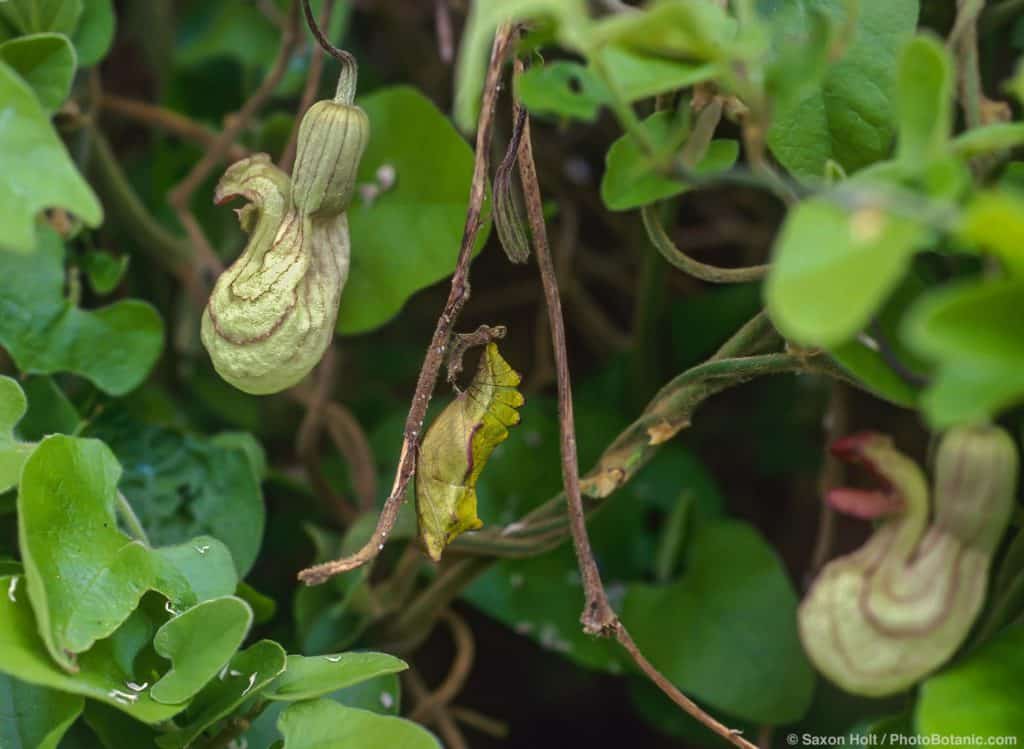
Aristolochia californica, California pipevine, with chrysalis of pipevine swallowtail butterfly
California pipevine (Aristolochia californica) is one of the first plants to flower in my northern California garden, sending forth dozens, no hundreds, of tiny blossoms on leafless stems in mid-winter, after the manzanitas but before flashier plants such as native irises grab center stage. Their appearance, noticed only up close at first, signals the approaching end of winter and fuels my anticipation of full-on gardening weather.
The flowers are, to say the least, unusual. They grow more like fruits than flowers, maturing, right before your eyes, from a millimeter or two to an inch and a half long on the vine. Most plants hide their flowers in one way or another before they spring into view, full size, at maturity. On plants of California pipevine, you can see the tiniest immature flowers alongside partially mature and mature flowers at the same time. I go out daily to check on the progress of tiny flowers I saw the day before.
Aristolochia californica flower
Reputed to prefer lots of moisture, even riparian sites, California pipevine seems to do quite well with little or no summer water in shade to part shade or at least afternoon shade, even on the inland side of central California’s coastal hills. While the upper leaves seem to like some sun, the roots must be cool, especially in hot summer weather. I have one planted in an oversized clay pot that receives morning sun but is fully shaded on summer afternoons by a second-story deck. I attached the vine to a deck post and strung it along the joists, mostly because I wanted to see the details of the individual flowers and the bright green heart-shaped leaves. In nature it is often a tangle of stems with a mass of old leaves along with the new, as some spent leaves tend to stay on the plant well into the following year.
California pipevine is the only host plant of the native pipevine swallowtail, which is why I planted it in the first place. I have yet to see a single caterpillar on my plants, but hope, even hope in vain, is what keeps gardeners going. The leaves are said to produce a toxic chemical that, when ingested by caterpillars, makes them and the butterflies they become unattractive to predators. I cannot attest to any of this as I have not seen a pipevine swallowtail in my garden.

Aristolochia californica, California pipevine, used as sprawling groundcover
You will hear that California pipevine is slow to start, even hard to grow. That has not been my experience. The first year I planted my vine in the pot underneath the deck it was ripped out, likely by a raccoon. I stuffed it rather hastily back in the pot, unwilling to just let it go, and in weeks it was showing signs of new life. The first year it grew perhaps six feet tall, no flowers. The second year it had many flowers and had extended its reach perhaps twice that high. By the third year it was covered in flowers and had reached more than twelve feet. This winter, six years in, it is easily fifteen feet in full extent and the flowers are coming out an inch or two apart.
This is a vigorous, robust, vital native California plant with great habitat value, well worth a place in any summer-dry garden. It is native to central and northern California in foothill woodlands, chaparral, and mixed evergreen forests, usually but not always on sites that provide at least some moisture year-round.

Share This!
12 Comments
Leave A Comment
Related Articles

By: Nora Harlow

By: web@thegardenofwords.com

By: Nora Harlow

I would love to plant this in my garden (Altadena, CA) however do you know about it’s reseeding or suckering habits? I’m hesitant to plant vines that quickly get out of control (eg: passion vine and morning glory)
Hi Megan,
California pipevine is not invasive or even rampant the way so many other vines are. It does get a bit ragged looking what with a few brown leaves hanging on well into the next growing season, but these are soon vastly outnumbered by bright green new leaves. Plants also tend to get overgrown (that is bushy and rambling) if not either tied up as a “climber” or periodically groomed. But I’ve not seen any reseeding or suckering of this fascinating vine.
Nora
Hello Nora
…just wondered if you’d seen this post on bored panda about pipevine swallowtails? Perhaps you could work together somehow???https://www.facebook.com/boredpanda/posts/10154395131874252
Love Cathy x
I’ve read that the flowers have an “unpleasant odor”…do you find this to be true? I was considering planting it near my patio along a pathway and near some apple trees
I believe you will have to bring in larva to get the butterflies, since they only survive on that plant it’s not likely they will just happen upon your backyard when no other plants are in the area.
Is it summer dormant ?
Yes it goes deciduous by mid summer.
Hello Joseph,
California’s pipevine is winter-deciduous, but the seasons tend to come early for this interesting vine. Except in part shade and with some summer water, leaves begin turning brown and may drop in late or even mid-summer, when it seems to rest or enter semi-dormancy. Flowers and then new leaves may appear as early as late winter and plants are in leaf by early spring.
Nora
I just found a pipe vine swallowtail caterpillar in my yard. There must be pipe vine nearby, and I’d sure like to get a few plants going. The butterfly is gorgeous!
Hi Belinda!
Thanks for sharing your great good news! If you love butterflies and you love birds, there is little more exciting than finding a caterpillar munching your plants or exploring your garden. If your garden is not large, you may need only one pipe vine as they can be quite large at maturity.
Nora
I visited the Ruth Bancroft Garden in Walnut Creek CA, Spring/summer of 2022. where I found a huge patch of pipe-vine growing under a large oak tree. I was told that that the butter fly can smell them from miles away. They had lots of caterpillars that spring. The pipe vine swallowtails also has a way to determine if sufficient # of leaves are available to feed and shelter the caterpillars or so I was told. Finally after 5 yrs, 2 moves, drought and freeze I had about 10 blooms. I’m so happy.
Wonderful news Teena! Let us know if you get caterpillars.
Nora