Some Easy, Well-Mannered Ornamental Grasses
Share This!
Ornamental grasses are eye-catching at almost any time of year, but there is something about the light in early fall that brings them to the fore. The tawny, dry seedheads of warm-season grasses and the anticipatory stirrings of cool-season grasses appear together as, despite the heat, days perceptibly shorten. You don’t need to plant a full-on meadow to get the effect. A few grasses set among flowering shrubs and perennials will do.

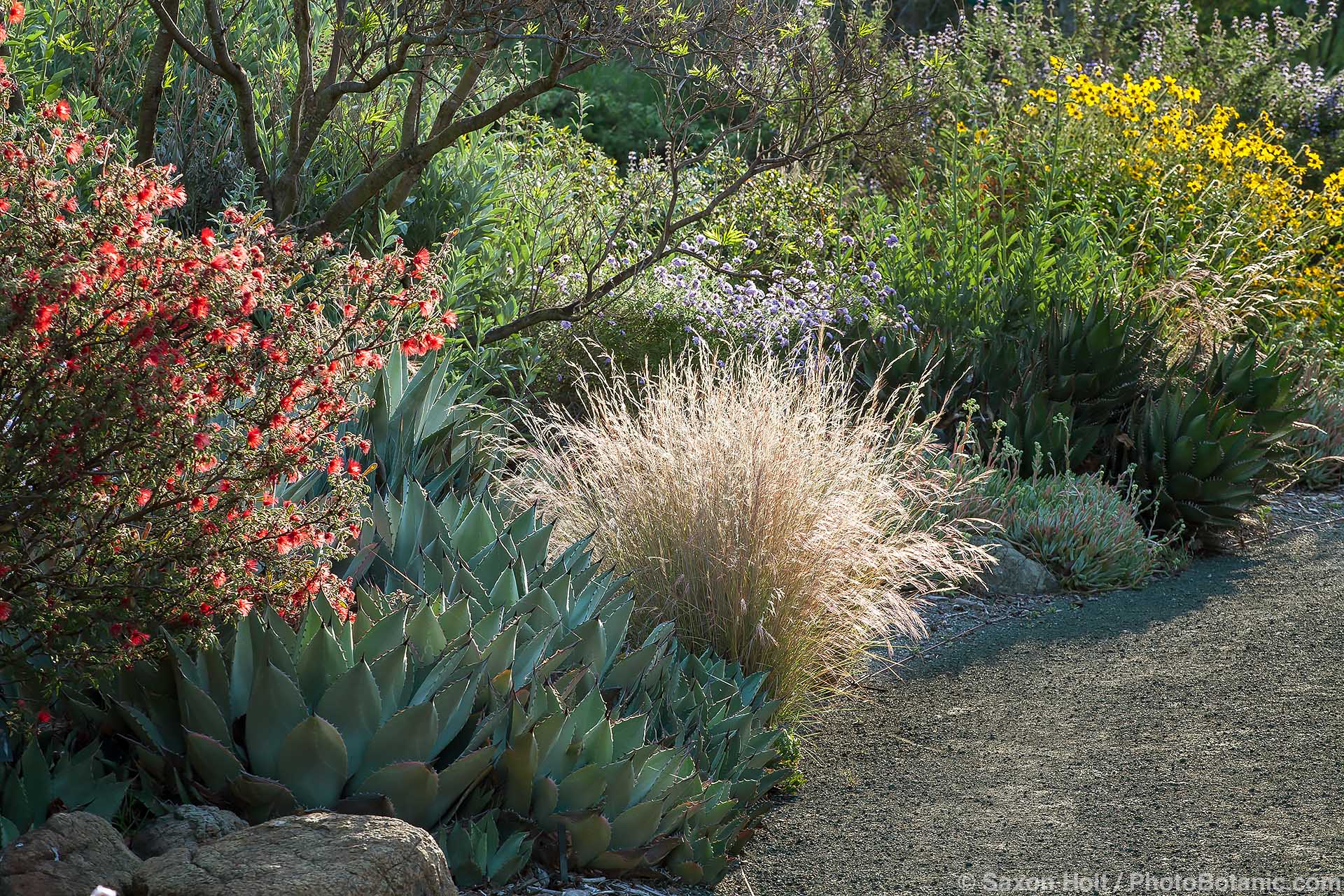
Aristida purpurea, purple three-awn, glows among shrubs, perennials, and succulents in Cal Poly’s Leaning Pine Arboretum in San Luis Obispo.
With so many ornamental grasses in the nursery trade it can be difficult to settle on just a few. Some grasses get huge. Others simply must have regular summer water to look their best. A few can be highly invasive in wildlands (e.g., Nassella tenuissima, Miscanthus sinensis, Stipa arundinacea) or difficult to control in the open garden (Leymus condensatus ‘Canyon Prince’ springs to mind). Where these beautiful grasses are sold their drawbacks are not necessarily advertised.
Cool-Season Grasses
If you are new to grass growing the fescues are a safe and instantly rewarding place to start. These cool-season grasses are easily worked into almost any garden design, and in mild-winter summer-dry climates they tend to be almost evergreen. Most look good with little maintenance and no cutting back. They can be refreshed by raking out old leaves with gloved hands.

Blue-leaved form of Festuca idahoensis, Idaho fescue, with late-summer seedheads
Festuca species and cultivars are mostly small grasses, tidy and well-behaved, with fine-textured, bluish gray or green leaves and dainty, mid-spring to early summer flowers. Their formal appearance lends itself to geometric planting designs, but they are just as effective in more natural arrangements among perennials and small shrubs. They are easily grown in mid-sized to large containers and are especially attractive among succulents. Away from the coast, fescues do best with occasional irrigation and some afternoon shade.
Festuca idahoensis, native to much of western North America, is 1-2 feet tall and wide with narrow leaves that range from pale green to bluish green to steely blue. ‘Siskiyou Blue’ is an especially blue selection. F. glauca, a European native, is smaller and has silvery blue-gray leaves. ‘Elijah Blue’ is a popular cultivar.

Calamagrostis foliosa retains its symmetrical shape year round.
Calamagrostis foliosa, Mendocino reed grass, is another exceptionally tidy, cool-season plant, about a foot tall out of bloom and 18 inches to two feet wide. Spring to early summer flowers are symmetrically arranged on arching stems above the pale green to grayish green leaves. Leaves may or may not take on purplish tones in late summer as the long-lasting flowers turn a luminous warm beige.
Native to coastal bluffs and forests of northern California, Calamagrostis foliosa prefers part shade and occasional water where summers are hot. It is easily distinguished from the widely planted feather reed grasses, C. x acutifolia ‘Karl Foerster’ and its variegated sibling ‘Overdam’, which are taller, bear bushy inflorescences on emphatically upright, 5- to 6-foot stems, and do best with regular summer water.

Helictotrichon sempervirens ‘Saphirsprudel’ may be offered as ‘Sapphire’.
Helictotrichon sempervirens, blue oat grass, looks rather like a large fescue, with a perfectly formed clump of narrow, spiky, blue-gray leaves 2 feet tall and 3 feet wide and flowering stems extending upward and outward another foot or so. Native to central and southwestern Europe, this cool-season grass is mostly evergreen with occasional summer water. Dried leaves that build up slowly over time are easily raked out with gloved hands as they appear or in a late-summer cleanup. Plants do not benefit from cutting back. This grass needs sun and and dryish, well-drained soils. It will rot in heavy soil if overwatered.

Sesleria caerulea is native to alkaline soils in meadows and forests of eastern Europe.
Seslerias, or moor grasses, are softer, less precise in leaf arrangement, and perhaps best massed as low groundcovers or used as fillers among taller plants. These small, clumping, cool-season grasses from southern and eastern Europe are long-lived in sun to part shade with occasional to moderate summer water. With decent drainage they grow well in alkaline soils.
Sesleria autumnalis is a foot to 18 inches tall and wide with mostly upright, yellowish green leaves and silvery white flowers held high above the foliage. A fall bloomer in colder climates, it blooms in spring in mild-winter summer-dry California. S. caerulea is similar but smaller with somewhat twisted, bluish dark green leaves and purplish black flowers in spring. S. ‘Greenlee Hybrid’ is believed to be a cross between the two and shows traits of both.
Warm-Season Grasses
As where winters are cold, in mild-winter climates most warm-season grasses will be semi-dormant in winter or at least not growing actively. Left to their own devices –not hacked back—their dried leaves and seedheads are attractive in the winter garden and provide shelter for birds, insects, and small wildlife.

Muhlenbergia capillaris in bloom in an Oregon garden
Muhlenbergias are fast-growing, warm-season grasses native to both the eastern and southwestern United States and Mexico. Perhaps best known is Muhlenbergia capillaris, native to the eastern states and wildly popular for its improbable haze of fluffy, purplish pink, summer flowers that rise high above the 3-foot mound of dark green leaves. M. capillaris can be cut back in late winter to promote fresh new growth in spring. It is best in sun with some summer water but adapts well to drier conditions.

Muhlenbergia dubia in a naturalistic planting at the University of California, Davis
Some of the best warm-season grasses for mild-winter summer-dry climates are muhlenbergias native to arid and semi-arid parts of the southwestern United States and northwestern Mexico. These grasses are adapted to dry summers with occasional moisture from monsoonal storms. Their late summer flowers remain upright and attractive as seedheads well into winter.
Muhlenbergia lindheimeri, native to central Texas, forms a 4-foot clump of blue-gray leaves and purplish flowers that age to white on 5- to 6-foot stems. M. rigens, native to California, is 3 feet tall and 3-4 feet wide, with yellowish green leaves and narrow, creamy white flowers on 4- to 5-foot stems. M. dubia, native from eastern Arizona to southern Texas and northern Mexico, is smaller than both M. lindheimeri and M. rigens, 2-3 feet tall, with an upright symmetrical display of creamy white flowers on 3- to 4-foot stems.

Muhlenbergia lindheimeri ‘Autumn Glow’ (front) with M. rigens in a California garden
Two other easy, adaptable, and well-behaved bunch grasses are Sporobolus heterolepis and S. airoides, both fairly new to the landscape trade but long used in habitat restoration and revegetation of degraded sites. Both are adapted to a wide range of soils from sandy to clay and to both drought and seasonal inundation. Although the genus name Sporobolus is said to mean seed thrower in ancient Greek, these two grasses do not seem to reseed in the garden.
Sporobolus heterolepis, prairie dropseed, forms a low mound, 1-3 feet tall and 2-3 feet wide. Its fine-textured, mid-green, arching leaves turn bronzy gold in fall. Oddly scented flowers are borne on 3- to 4-foot branching stems in summer, well above the foliage. Flowers are followed by attractive, long-lasting, pinkish seedheads. S. heterolepis is native to the tallgrass prairies of central North America from Texas to southern Canada. Plants do best in sun with good drainage.

Sporobolus heterolepis with perennials in the Denver Botanic Garden
Sporobolus airoides, alkali sacaton, is similar to S. heterolepis but with gray-green leaves. Its pinkish summer flowers age to tan. This adaptable grass is native to seasonally moist alkaline flats, coastal scrub, and desert shrublands and grasslands throughout much of western North America. It thrives in almost any soil, from sandy or gravelly to heavy clay, and with varying amounts of summer water, including none along the coast. Plants can be refreshed by cutting back hard in fall every few years. They don’t need this treatment every year.

Share This!
Related Articles

By: Nora Harlow

By: Saxon Holt

By: Saxon Holt