September 2025 Newsletter: September Grasses

Share This!
Greetings, friends –
It’s September. It’s almost autumn; our gardens are holding on as they await the rainy season, and by the end of the month, the days will be shorter than the nights. There is not much drama in the garden – unless you have ornamental grasses.
We love grasses and many are well adapted to summer-dry climates. Indeed, across the globe many grassland ecosystems, from savannahs to prairies, steppes, veldts, and pampas all have deep rooted grasses well adapted to drought and dry summers. Many have dramatic flowers and by now are showing off in the garden.
We feature grasses this month and hope to give you some ideas as the planting season is now upon us. Have you ordered your bulbs? They are a classic addition to grass gardens and meadows.
~ Saxon Holt and Nora Harlow
September Blog Post: Some Easy, Well-Mannered Ornamental Grasses
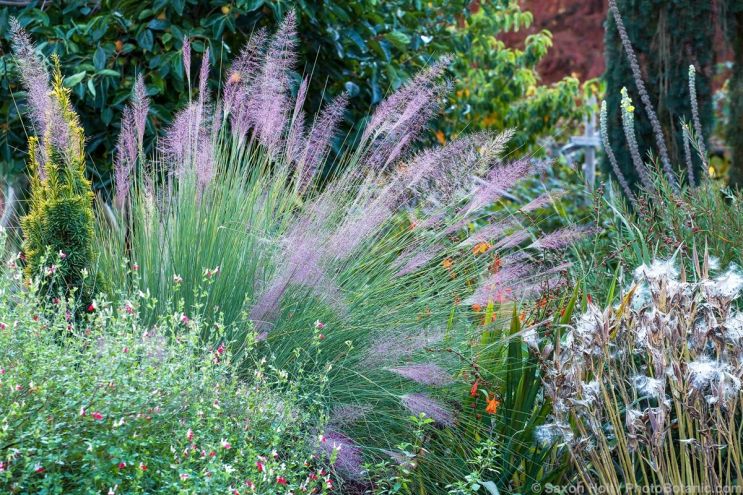
Ornamental grasses are eye-catching at almost any time of year, but there is something about the light in early fall that brings them to the fore. The tawny, dry seedheads of warm-season grasses and the anticipatory stirrings of cool-season grasses appear together as, despite the heat, days perceptibly shorten. You don’t need to plant a full-on meadow to get the effect. A few grasses set among flowering shrubs and perennials will do.
Read On
Instagram Memories

Sept. 7, 2022
Dasylirion longissimum has a strong architectural shape and is ornamental any time of the year, especially now that everything is dried up and nearly dormant.
Follow Us on Instagram
The Versatility of Grasses:
Grasses offer tremendous versatility in garden design, well beyond standalone beauty. In combination with more stiff and static plants, grasses soften a border, move with the wind, and capture light with glorious seedheads.
Homeowners usually think of grasses as groundcover, as lawns; but ecological gardeners have moved beyond those water-sucking monocultures and use grasses as meadows where an open area of the garden needs groundcover.
This small Southern California garden designed by John Greenlee uses several different grasses as a lawn alternative in small panels, defined by stepping-stone paths.

Grasses offer a great design counterpoint to difficult-to-use succulents, which often need companion plants to soften their stiff architectural shapes. Traditional garden plants can be difficult with succulents which usually want dry soils and need excellent drainage. But many grasses also like dry summers and need little special care.
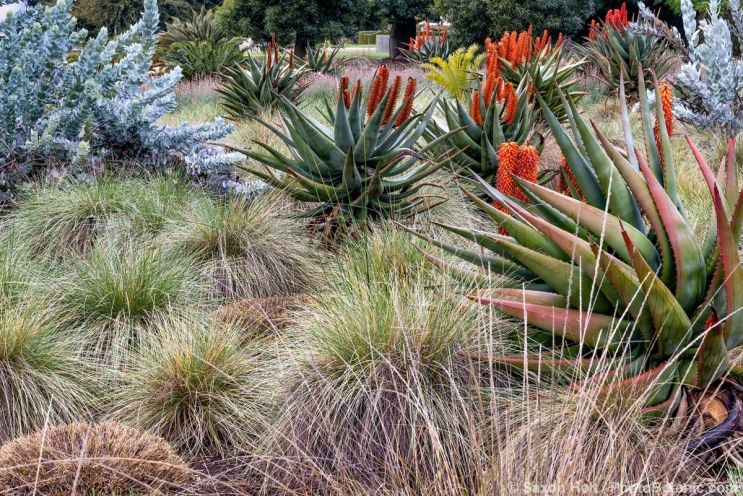
This ‘succulent bushland’ at the Huntington Library uses Festuca mairei where once there was a large lawn, among large Aloe ferox, as a very simple but effective drought-tolerant replacement for a large lawn.
This time of year warm season bunch grasses really show their glory when backlit in the garden, as the lowering sunlight highlights their dramatic seed heads.

Here, purple fountain grass Pennisetum setaceum ‘Rubrum’ stands out against a dark hillside in the shade. This photograph was taken in bright light which, when exposed for the grass highlights, makes the background go nearly black.
Get More Ideas in our Book
Links We Like
Because grasses are so easy to grow, many can be invasive and spread from the garden to the ecosystems beyond. 95% of California’s native grasslands have been overrun with grasses brought by the early European settlers. This link to Invasive and Exotic Grasses from the Center for Invasive Species and Ecosystem Health covers all of North America.
We would love to hear about any resources you would like to pass along. We all get these snippets from our news feeds and inboxes. Let’s share the best and we will keep a running list so you can find them later on the Links We Like page.

Share This!
Related Articles

By: Nora Harlow

By: Saxon Holt

By: Saxon Holt