Banksias

Share This!
Both banksias and dryandras bear flowerheads composed of hundreds or thousands of tiny paired flowers and both are endemic to Australia. Banksias and dryandras both are now in the genus Banksia, the 93 to 94 species of Dryandra having been merged in 2007 with the 78 to 80 species of Banksia. Despite the merge and their shared traits and provenance, the two groups remain distinctive in ways that may be of interest to gardeners and garden designers.
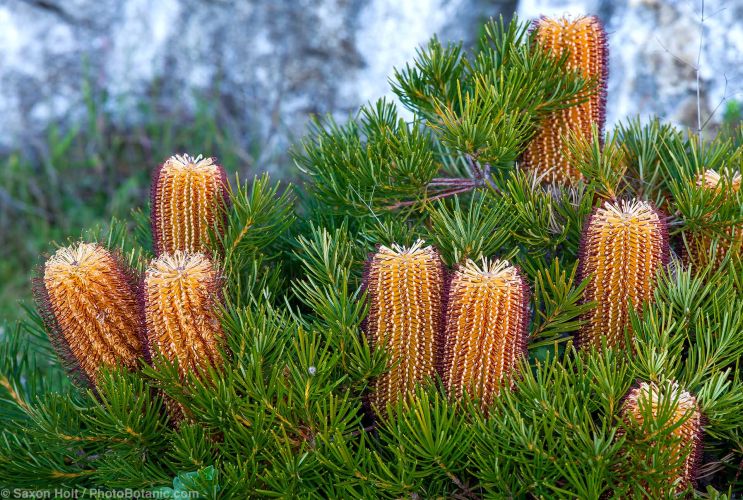
Banksia spinulosa ‘Coastal Cushions’ bears the upright flower spikes for which the genus is best known.
Flowers of all of the banksias except three are borne in upright, narrowly to broadly cylindrical, woody spikes. Flowers of all dryandras are borne in dome-shaped or rounded (capitate) heads. In most banksias and all dryandras flowers are surrounded by leafy bracts. In banksias the bracts are usually inconspicuous. In at least a dozen dryandras the bracts are prominent and showy as in many other members of the protea family.

Banksia fraseri (formerly Dryandra fraseri) bears flowers in dome-shaped heads characteristic of dryandras.
Fruits of both banksias and dryandras dry to form capsular follicles each of which contains one or two winged seeds. In banksias the follicles are deeply embedded in the woody, conelike spikes that held the flowers. In dryandras the follicles are loosely attached to a flat or slightly curved woody base. Not only are the visual effects quite different. Banksia follicles are tightly held within the fire-resistant “cone” and many release their seeds only when heated by bushfire. Dryandra follicles are loosely attached and more easily opened so seeds are more readily shed.

Seed-bearing follicles of Banksia baxteri are deeply embedded in the woody, conelike remnant of the flower spike.
As a group, dryandras tend to be smaller plants than banksias, more easily worked into smaller garden designs. Most dryandras range from prostrate to low or medium-sized shrubs while most banksias are fairly large shrubs or trees at maturity.
There are exceptions. Both groups include some species that reach the size of small or large trees as well as prostrate forms or cultivars of some typically treelike species. Banksia sessilis (formerly Dryandra sessilis), with hollylike leaves and pale yellow flowers, can reach 18-20 feet tall. B. ‘Roller Coaster’, with smooth-margined leaves and lemon yellow flowers, is a widely spreading prostrate cultivar of B. integrifolia, which typically grows as a medium to large tree.

Banksia integrifolia, here featured as a small multi-trunk tree, grows naturally as a medium to large tree.
Leaves of both dryandras and banksias are highly varied. Dryandras are known for their unusual leaf shapes and often are grown primarily for their foliage effects. Many dryandras have leaves that are deeply divided into triangular or oblong lobes, often with sharply pointed tips. Others are narrow with finely or prominently toothed margins. Some are flat, in others the margins are rolled under, often with dense grayish hairs beneath. With long, pinnate leaves and regularly spaced, smooth-margined lobes, some dryandras appear almost fernlike. New leaves may be covered with rusty brown hairs.

New leaves of Banksia drummondii (formerly Dryandra drummondii) are covered with rust-colored, woolly hairs.
Although known primarily for their long-lasting, showy flowers, banksia leaves are almost as varied as those of dryandras. Banksia ashbyi has leaves with triangular lobes similar to many dryandras. B. ericifolia and B. spinulosa have leaves with short, narrow, needlelike leaflets resembling Erica species or rosemary. B. integrifolia has leaves with smooth-margined leaflets, thick and leathery, dark green above and silvery white-hairy beneath. The leathery, dark green, triangular leaflets on the long, narrow leaves of B. grandis are sharply pointed and finely serrated along the margins.

Leaflets of the treelike Banksia grandis are leathery, dark green, and triangular, softly hairy beneath.
Cultural requirements of banksias and dryandras can differ markedly, depending to a large extent on climate and soils where the species are naturally found. All dryandras are endemic to winter-rainfall southwestern Western Australia in sandy or gravelly, low-nutrient, often slightly acidic soils where they receive little or no summer water.
Most banksias also are native to southwestern Western Australia, but some grow naturally in summer-rainfall eastern Australia. There they are found in environments ranging from coastal sands to subalpine forests. One or another of the eastern banksias can be found from the Eyre Peninsula in South Australia around the coast and up to the tip of northern Queensland.
As if to underscore the differences between the two groups in their cultural requirements and tolerances, no Banksia species is native to both eastern and southwestern Australia. Banksias native to southwestern Australia may struggle in the higher humidity and heavier, more fertile soils common to parts of eastern Australia. They also may not succeed in the richer, irrigated soils of the cultivated garden.

Banksia ericifolia is an adaptable eastern Australian banksia with many commercially available cultivars.
All banksias and all dryandras need fast drainage, even those few that grow naturally in moist soils. Most prefer sun and need good air circulation. All are sensitive to phosphorus and the application of fertilizers with significant amounts of this nutrient will kill them. All need reasonable amounts of water. While many grow naturally where annual rainfall is less than 15 inches, no commercially available Banksia species is native to truly arid environments.
Some banksias are more adaptable than others. Banksia ericifolia is a mid-sized shrub to small tree, variable from six to 20 feet tall in the wild. Native to acidic, sandy soils of summer-rainfall eastern Australia, it can be grown successfully in moist but well-drained clay. Its golden orange fall and winter flowers are large and showy, especially in ‘Giant Candles’, a hybrid with B. spinulosa. ‘Little Eric’ is a dwarf selection, 3-6 feet tall. ‘Coastal Cushions’ is another adaptable, compact selection. ‘Fireworks’, frost hardy to below 20 degrees F., is 8 feet tall and 6 feet wide with red and orange flowers.
Banksia spinulosa, native along the coast and in the mountains of eastern Australia, grows well in soils ranging from light to moderately heavy with moisture and good drainage. Its golden yellow flowers are long lasting, from fall through winter to spring. Its various forms are said to be easy and low maintenance in gardens. ‘Birthday Candles’, 18 inches tall and 3-4 feet wide, is frost hardy, has a high tolerance for salt-laden winds, and can be grown in acidic or alkaline soils. ‘Schnapper Point’ is 2-4 feet tall and 4-6 feet wide with gold and red fall and winter flowers.

Banksia undata (formerly Dryandra praemorsa), is one of the most adaptable of the dryandras and blends well with other summer-dry plants.
Banksia undata (formerly Dryandra praemorsa) is 6 feet tall and 3 feet wide with pale yellow winter flowers and prickly dark green leathery leaves. This is one of the easiest and most adaptable of the dryandras, growing well in most reasonably drained soils, including clay, in full sun or part shade. Native along the south coast of Western Australia on sand dunes and sea-facing cliffs, it accepts strong winds and salt spray as well as extended dry periods. ‘Red’ is taller, to 12 feet, with grayish green leaves and large, wine red flowerheads in winter and spring.
There are many more adaptable Banksia species and cultivars available to gardeners and garden designers today than there were some years ago. Long grown in gardens in Australia, these groundcovers, shrubs, and trees are now becoming rather widely available outside of Australia. More than two dozen banksias are currently on offer within five to fifty miles of my northern California garden. Seeds of many more are available online. If you garden in a mild-winter climate and haven’t already done so, why not give banksias a try?

Share This!
Related Articles

By: Nora Harlow

By: Nora Harlow

By: Nora Harlow