Maples of Coastal Western North America
Share This!
Maples (genus Acer) are native to much of the temperate northern hemisphere, but their distribution within this wide geographic range is decidedly uneven. Of the roughly 120-130 species worldwide, more than 100 are found naturally in China and 24 in Japan. Depending on how species are classified and regions are defined, nine or ten are native to Europe and western Asia. Twelve or thirteen are native to North America. Coastal western North America has four.
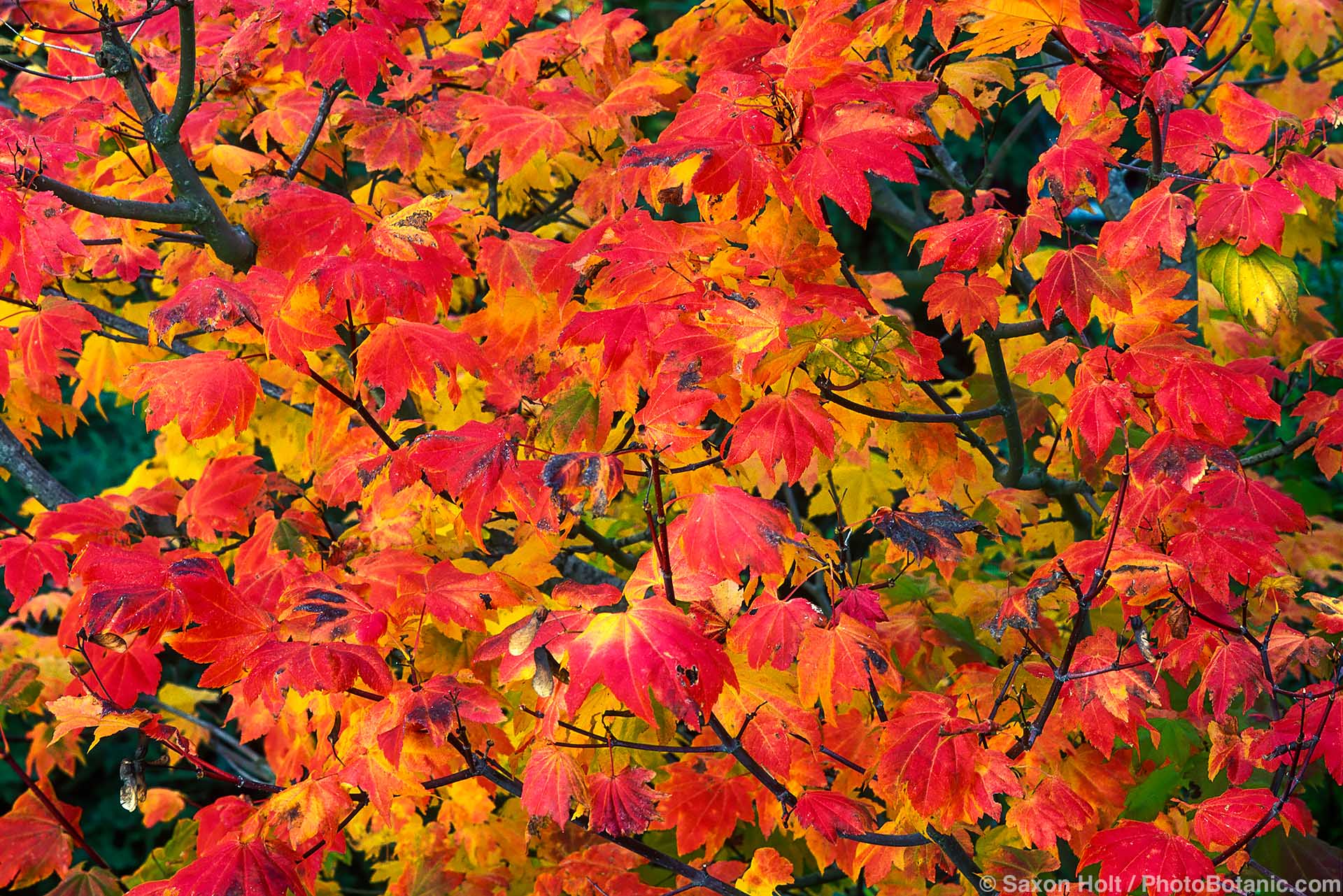
When conditions are right, Acer circinatum (Pacific coast vine maple) can rival Japanese maples in its fall color display.
Maples are widely known and grown for their fall leaf color, which varies in intensity by species as well as with soils, aspect, climate, and annual variations in timing of local weather. Some of the best displays occur in eastern North America, where fall typically brings the requisite warm days and cool nights, and in Japan, where many especially colorful species are naturally found.
Maples of temperate climates are deciduous and broadleaved, clearly distinguished by the opposite arrangement of their usually lobed and palmately veined leaves and by winged seeds (samaras) that are joined together in pairs. In most other ways maples are quite diverse.
Of the four maples native to the Pacific coast, two –bigleaf maple (Acer macrophyllum) and vine maple (A. circinatum)– are endemic to coastal and near-coastal parts of western North America. A third –the weedy box elder (A. negundo)– is more widely distributed throughout much of North America. A fourth species –the often shrubby Rocky Mountain maple (A. glabrum)– grows naturally along the northwestern coast but occurs primarily farther inland in the eastern mountains and basins of the North American cordillera.
Fast-growing for the first ten or fifteen years, Acer macrophyllum typically matures at around 50-60 feet tall and almost as wide, but reportedly can reach 100 feet or more under ideal conditions. Bigleaf maple is native from coastal southwestern British Columbia south to the mountains of central and southern California.

Acer macrophyllum, bigleaf maple, is a large tree with an irregular crown and shallow, widespreading roots.
Bigleaf maple is found from sea level up to about 1,200 feet in British Columbia and at gradually increasing elevations up to 7,000 feet to the south. This distribution reflects its sensitivity to both cold temperatures and drought. It prefers damp woodlands, streamsides, and canyon bottoms, but mature trees are sometimes found in sunny, dry locations, usually in moisture-retentive soils or at the base of well-drained slopes. Seasonal inundation is accepted, but trees do not survive long in standing water.
Fall color in the bigleaf maple is usually brownish yellow and leaves drop early if both summer and fall are hot and dry. Winter and spring are its most glorious seasons. In winter the summer-dormant mosses and lichens that cover the bark explode into thick mats of rich green lushness. In spring long, drooping clusters of greenish white flowers drip from the branches, soon joined by red-tinged, unfurling new leaves. ‘Seattle Sentinel’ is a columnar selection.

Acer macrophyllum with spring flowers and unfurling new leaves
Acer circinatum, vine maple, is a small, sometimes sprawling, often multistemmed, shrubby tree 6-20 feet tall, native at low elevations from southwestern British Columbia to northern California. Favoring shady, at least seasonally damp, wooded sites, where it may form thickets by rooting of branches that touch the ground, it also is sometimes found in full sun, where it colors up nicely in fall. Bark is reddish brown and the bright green leaves have a reddish cast when new. ‘Pacific Fire’ has especially bright red young twigs.

Acer circinatum, vine maple, forms a lacy green hedge in a Seattle garden
Acer glabrum, Rocky Mountain maple, is a small, usually multistemmed tree native from southeastern Alaska south to California and east to Montana and New Mexico. It is found in wetlands, along streams, in canyons, and on mountain slopes at elevations ranging from 1,100 to 4,700 feet in British Columbia to between 5,000 and 12,700 feet in Colorado and Utah. Rainfall ranges from nine inches to 60 inches a year. This adaptable tree grows best in sun but is fairly tolerant of shade. It is cold hardy but suffers in extreme heat.
Acer negundo, box elder, is a fast-growing, short-lived, mid-sized to large tree native to much of North America, especially east of the Rocky Mountains. Adapted to a wide range of soils and moisture conditions, it spreads widely by seed and suckering and is considered invasive in parts of North America, South America, Europe, and Asia. Its light green leaves turn yellow in fall.

Share This!
Related Articles

By: Nora Harlow

By: Saxon Holt

By: Nora Harlow