The Grassy Nolinas
Share This!
Nolinas are a varied lot. Collectively marketed as grasslike plants and deceptively small in gallon cans, some will become small trees in the swiftly passing span of twenty years. Others will rise up on sturdy five- to eight-foot stems covered with downward-hanging older leaves like miniature palms. All 30-plus species of Nolina have their place in the summer-dry landscape. For gardeners and designers seeking a plant that retains its grasslike appearance, the list of possibilities is shorter.

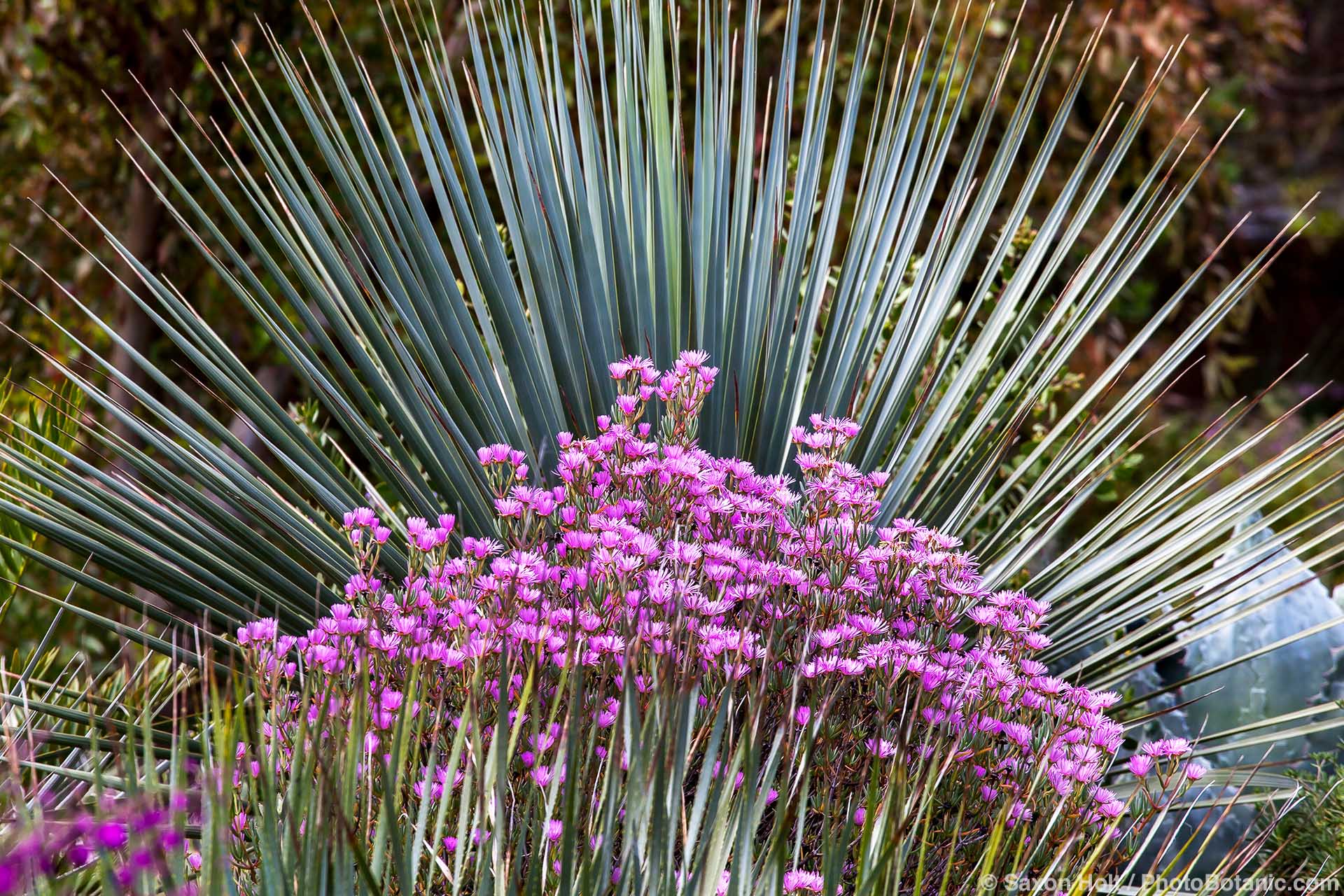
Nolina nelsonii, native to the mountains of Tamaulipas, Mexico, can eventually reach 8-12 feet tall on a sturdy stem. N. parryi, from the Peninsular Ranges of southern California, is similar but with olive green leaves and, depending on subspecies, a 6- to 12-foot stem.
Nolina is a genus of flowering monocots native to Mexico and the southern United States. All form rosettes of long, narrow, lax or stiffly upright leaves. Rosettes are either held atop a water-storing stem (caudex) or emerge directly at ground level from an underground water-storing root or stem. Plants may produce several to many rosettes from the same caudex, eventually forming a small colony.
At maturity, which can take many years, separate male and female plants bear hundreds or thousands of tiny, whitish, spring or early summer flowers on sometimes astonishingly tall stems. On female plants, if pollinated, flowers are followed by hundreds or thousands of decorative papery seed capsules. As with Dasylirion, to which nolinas are closely related, rosettes do not die after flowering but usually will not flower every year.

Nolina parryi flowering in the Mojave Desert section of California State University’s Fullerton Arboretum
Of the truly grasslike nolinas –those that do not form an aboveground stem– some of the best are Nolina texana, N. greenei, N. micrantha, N. lindheimeriana, and N. microcarpa.
Nolina texana is probably the plant most commonly grown in gardens. This is a clumping nolina, 2-3 feet tall and 3-6 feet wide with narrow, stiff and wiry, dark green leaves and spring to early summer flowers on short stems within or barely above the foliage. It is native to alkaline soils of grasslands, shrublands, and rocky hillsides up to 7,000 feet in south-central Texas, New Mexico, and northern Mexico.
Nolina greenei is similar to N. texana and was formerly considered the same plant. N. greenei now refers to plants native from central New Mexico north to southeastern Colorado and the extreme western portion of the Oklahoma panhandle. It has slightly wider leaves with finely serrated margins.
Nolina micrantha is another clumping plant similar to N. texana, differing primarily in the distinct purplish cast of the flowers and a later bloom time extending into summer. N. micrantha is native to rocky limestone slopes and sandy grasslands from 3,600 to 4,600 feet in the Guadalupe Mountains of west Texas and southeastern New Mexico.

Nolina lindheimeriana planted as a groundcover in southern California
Nolina lindheimeriana, often mistakenly referred to as N. lindheimeri, is a variable plant, sometimes remaining at 2-3 feet tall for many years, at other times reaching 4-5 feet tall and 4-6 feet wide. Arching green leaves are flat, narrow, and finely toothed with curly filaments at the tips. Flowers are held on tall stems, well above the foliage. This plant is native and endemic to open woodlands in the eastern half of the Edwards Plateau in central Texas.
Nolina microcarpa, to 4 feet tall and 5 feet wide, is native to desert grasslands, woodlands, and chaparral between 3,000 and 6,000 feet in Arizona, New Mexico, and northern Mexico. Leaves are narrow, almost wispy, and early summer flowers are held above the foliage on 6- to 7-foot stems.

Grassy nolinas are excellent additions to low-water landscapes where summers are dry. At home here is Nolina texana in a New Mexico garden.
All of these grassy nolinas are long-lived and low maintenance where good to excellent drainage can be provided. All will survive with no summer water once established but prefer occasional watering –enough to mimic the summer monsoons to which they are adapted. Site them in full sun with part shade in the afternoon where summers are especially hot and dry.

Share This!
Related Articles

By: Saxon Holt

By: Saxon Holt