Making the Most of Zone Zero
Share This!
A sea change in landscape design is coming to California, at least for properties in the recently expanded classification of Very High Fire Hazard Zone. New regulations associated with Assembly Bill 3074, enacted in 2021, will require property owners in such zones to create and maintain a non-combustible clearance next to any structure. This area, known as Zone Zero, is to be kept free of anything that will burn, including but not limited to vegetation.

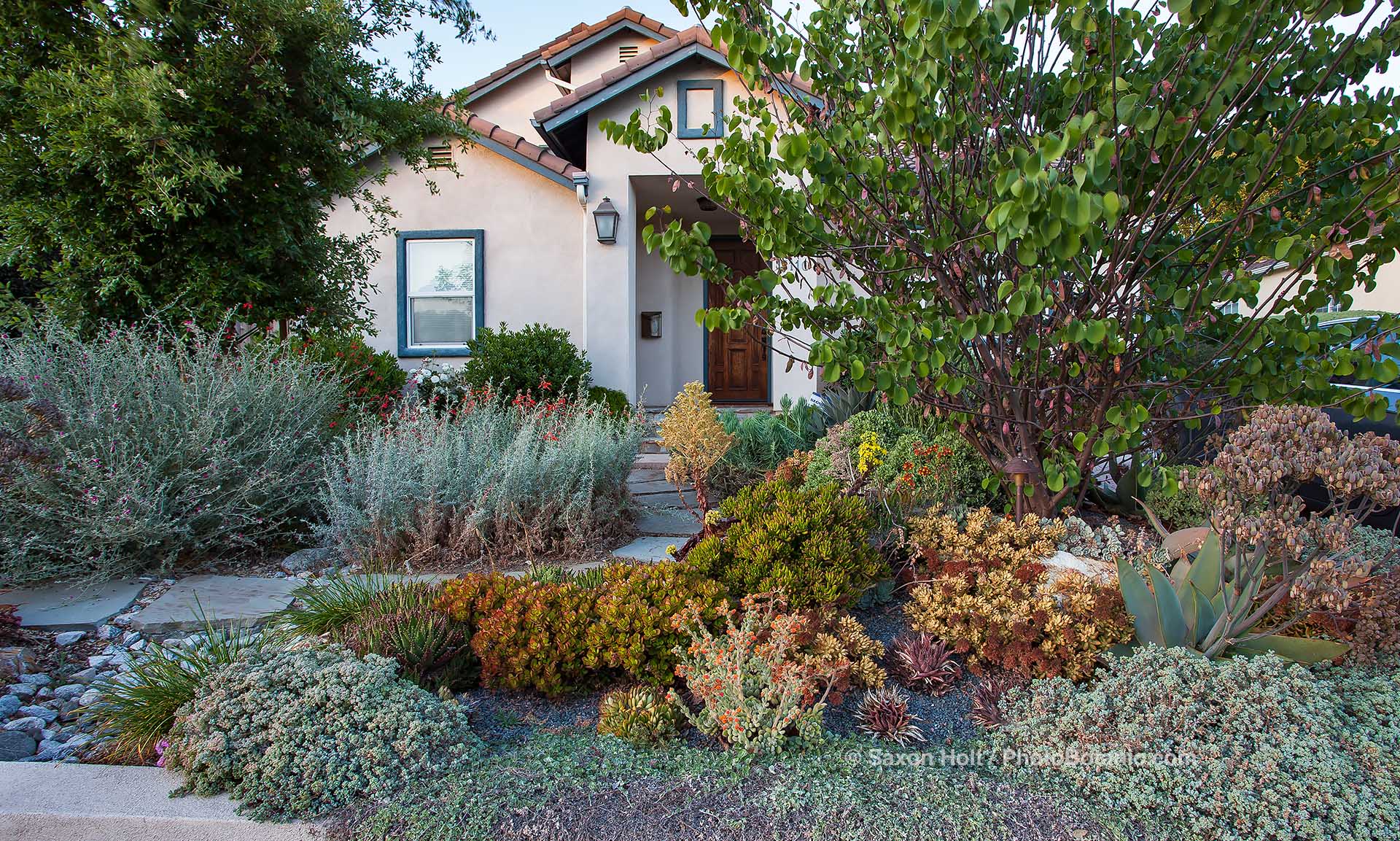
Some of the most pleasing landscape designs today almost hide the house.
In its dimensions the change seems small, affecting only five feet immediately around any structure, but around structures, and especially around homes, is exactly where garden design has long devoted much of its most focused attention. Plants are sited to screen the foundation and essential utilities, soften the hard edges of the architecture, ground the house in its natural surroundings, and guide visitors to the front door. Some of the most pleasing landscape designs today nearly hide the house.
In the short run, only properties in the highest fire hazard zones will be affected. Over time, given the warming climate and the vastly increasing scale of wildfires globally, a dramatic shift in the design of private and public landscapes, as well as entire communities, can be expected.

Plants can be placed within the five-foot clearance if they are irrigated, widely spaced, and in non-combustible containers.
Many homeowners likely are concerned that compliance with the law will lower the value of their property or at least negatively affect its aesthetics. Yet even a simple five-foot clearance can be attractive if well done. Those in a position to consider more substantial change, or those in the planning stages of new construction, may view it as an opportunity to rethink the forms and functions of the home landscape.

A partially covered patio offers choices of seating in sun or shade. The underside of the overhang is finished with a Class A fiber-cement material that does not ignite.
Start by considering the indoor floor plan. From which parts of the house is the garden most accessible and how might these adjacent outdoor spaces be used? This is where the five-foot clearance can be expanded to ten, fifteen, or even twenty feet if space allows. Typically these outdoor spaces are off the living room or family room, but they could be almost anywhere. Easily accessible flagstone, brick, or concrete patios immediately adjacent to the house can significantly expand usable living space. They also lend a feeling of spaciousness to adjacent indoor rooms.
In siting outdoor living areas microclimate will be as important as ever, not for plants but for people. Where is it sunniest in the morning or afternoon? Does the space you’ve selected for outdoor use need protection from prevailing winds? Will you be wanting to use the space in the winter? In the rain? On hot summer days? Planted windbreaks can be effective even when sited well away from the house and roof overhangs can be designed to resist fire.

A slate patio sheltered from winds offers a private space for relaxing and a spillover space for indoor-outdoor entertaining.
Views from indoors and from adjacent outdoor spaces are also a prime consideration. What will your guests see from the living room and what will you see from the kitchen sink? Daily living is greatly enhanced by a landscape designed to be viewed from indoors or from the patio where you take your morning coffee. Plantings can be designed to be viewed from the house or even from all sides instead of primarily for curb appeal from the street.
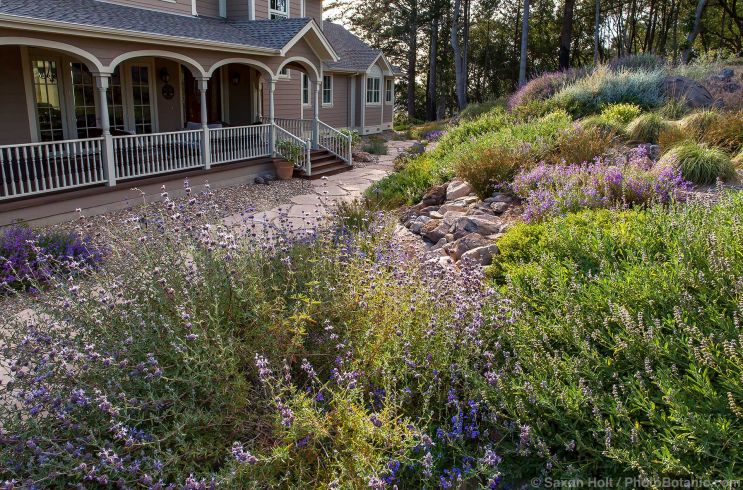
Some of the best views of this colorful slope planting are from the house and from the deck.
The details of the new regulations are still being worked out, but as of now it seems likely that some exceptions may be allowed within the five-foot clearance. Plants under a specified height may be permitted if they are irrigated and in widely spaced, non-combustible containers. Routinely irrigated and mowed turf may be acceptable if kept some specified distance from the foundation. Wood fences parallel but not attached to the house may be allowed for existing homes but not for new construction.

Mowed and irrigated sedge (Carex pansa) turf extends the fire-resistant zone beyond the concrete patio.
Whatever the final wording of the regulations may be, the removal of foundation plantings will change the appearance of structures within the landscape. Although perhaps initially unsettling, full exposure of the house can be functionally as well as visually liberating.
Maintenance is simplified and less maintenance is required when the foundation, siding, and utilities are protected from advancing roots, moisture buildup, and poor air circulation. Freed from its vegetative trappings, the front door likely will be found to need no accentuating and the bold lines of the architecture to need no disguise.

The bold lines of the architecture are accentuated by low plantings of succulents in non-combustible pots.
Of course, not all properties are large enough to dispense with foundation plantings and locate plants further from the house. As homes increase in size and parcels get smaller, the principles of Zone Zero may be applied to entire new developments. Minimally vegetated, “hardened” homes may be sited in small clusters separated by irrigated parks, greenbelts, golf courses, or water features and protected around the perimeter by shaded firebreaks that slow the advance of wildfire. Urban planners, developers, government agencies, and many others are working on it. Stay tuned.

Share This!
Related Articles

By: Saxon Holt

By: Saxon Holt

By: Nora Harlow