Lupines
Share This!
To much of the world lupines (genus Lupinus) are a traditional source of food and fodder and a common means of improving agricultural soils. To forward-thinking plant breeders and entrepreneurs they are a promising source of high-quality protein, oils, and biomass for a wide range of green industries. To gardeners lupines are a reliable source of dramatic form and color in springtime beds and borders.
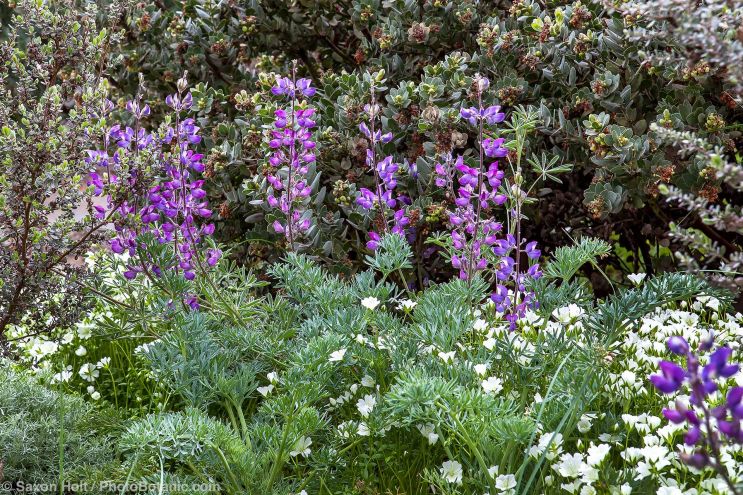
Lupinus albifrons, silver lupine, is native to coastal Oregon and California.
Depending on how they are classified, between 200 and 500 species of lupines are native to three regions of the world: the eastern and southern Mediterranean; western North, Central, and South America; and eastern North and South America. In all of these regions lupines have been used for hundreds or thousands of years as high-protein food and livestock fodder and as a green manure for cultivated fields.
The use of wild lupines as food for humans or animals requires special treatment to remove or reduce the toxic alkaloids contained in all parts of the plant, especially the seeds. The ancient Greeks, Romans, Incans, and indigenous North Americans evidently knew to soak the seeds in water for several to many days and then boil or roast and rinse them before consumption.

Lupinus latifolius, broadleaf lupine, is native from British Columbia to Baja California and New Mexico.
By the early twentieth century breeders had developed low-alkaloid (“sweet”) lupines that need no pretreatment. These are now widely cultivated for livestock feed, fish farming, and as a nutrient-rich component of breads, pasta, and fermented street foods in some parts of the world.
Researchers are anticipating a vast increase in the use of sweet lupines worldwide as high-protein, low-carbohydrate meat and dairy substitutes and in industries ranging from cosmetics to pharmaceuticals. Wild lupines and ornamental cultivars still contain the toxins and should not be consumed
The use of lupines to fertilize soils derives from the fact that, as legumes and members of the Fabaceae, they are able to convert atmospheric nitrogen into forms usable by plants through a symbiotic relationship with nitrogen-fixing bacteria. Some of this “fixed” nitrogen is available to other plants, especially when spent lupine leaves and roots are mixed back into the soil.

Lupinus succulentus, arroyo lupine, is an annual native to moist, heavy clay soils in California, Arizona, and Baja California.
The ability to fix nitrogen is beneficial for agriculture but can be environmentally either restorative or damaging. Lupines can thrive in low-nutrient and disturbed soils by improving soil fertility. In healthy ecosystems lupines outside their native range may displace native species and encourage invasion by other non-native plants. Alternatively, where ecosystems have been damaged lupines can serve as agents of ecological recovery.
Lupines are perennials or annuals, sometimes shrubs, with attractive, large or small, green to gray-green, usually palmate leaves and showy, upright spikes of blue, purple, white, or yellow spring and early summer flowers. Flowers are followed by hairy, pea-shaped pods containing a few to a dozen beanlike seeds, dark brown to black when mature. In nature, lupines are found in many different habitats from coastal dunes to rocky mountain meadows and desert washes; from dry to moist, loamy and acidic to well-drained, mildly alkaline clay soils; and from cool to warm or even hot summer climates.

Lupinus microcarpus, chick lupine, is an annual lupine native to many habitats from southwestern British Columbia to Baja California, including the Mojave Desert.
Most lupines readily available to gardeners today are hybrids of relatively few species native to western North America. Many are hybrids involving Lupinus polyphyllus, marsh lupine, a moisture-loving perennial found naturally along streams and in seasonally damp meadows from British Columbia and Alberta south to California. L. polyphyllus is a variable plant with large leaves and pinkish white to purplish blue flowers. It prefers cool summers and acidic soils but tolerates summer dryness and almost any well-drained soil.
Crosses of Lupinus polyphyllus with L. arboreus, a native of coastal western North America, are known as Russell Hybrids. These highly adaptable hybrids bear flowers in shades of red, pink, blue, yellow, or white and are often bicolored. Foot-long flower spikes are borne on stems that can reach almost three feet tall. Russell Hybrids are marketed under names such as Chatelaine (pink flowers), Chandelier (yellow), and The Governor (blue and white).
Other Lupinus polyphyllus hybrids include Gallery Hybrids and Minarette Mix, both with a similar range of flower color on plants under two feet tall. Plants marketed as Tutti Frutti Mix are full-sized hybrids that produce tall spikes of flowers in exotic bicolor combinations. Hybrid lupines are short-lived but self-sow freely and may spread aggressively in some regions. Offspring from seed of hybrid plants will not exactly resemble their parents.

Lupinus nanus, sky lupine, is a low-growing annual, 6-20 inches tall, native to the mountains of California and Nevada.
All lupines will bring hummingbirds, bees, butterflies, and other pollinators to the garden, but native lupine species play a vital role in local food webs and life cycles of beneficial native insects. Everyone knows by now that caterpillars of monarch butterflies feed only on milkweed plants. Lupines too are host plants for many native moths and butterflies and favored foods of native bees.
Species lupines are readily available as seed online and plants are available from specialty nurseries, especially those that feature native plants. Plants also can be found at sales of native plant societies and botanic gardens. Rarely and seemingly randomly, they may even appear in big box stores. The lupines photographed here are among the fifteen native species and varieties currently on offer within an hour’s drive of my northern California garden. A similar range of native species may or may not be available elsewhere.

Share This!
Related Articles

By: Saxon Holt

By: Saxon Holt