July 2025 Newsletter: High Summer Gardens Around the Globe

Share This!
Greetings, friends –
It’s high summer, the solstice has passed, and gardens have peaked; but if you have been watering efficiently, that peak is being sustained, and the garden is on autopilot. For summer color, we keep some choice pots on the patio to fuss over and fertilize (anyone confess to a soft spot for fuchsia and petunias?), and the early evening stroll in the garden is especially enjoyable knowing there is not much to do, other than to be sure the squirrels haven’t nibbled yet another irrigation line. The vegetable garden is its own set of chores and rewards, and we hope the birds and beetles are allowing you your fair share. It’s high summer–enjoy!
~ Saxon Holt and Nora Harlow
July’s Blog – The Grassy Nolinas

Nolinas are a varied lot. Collectively marketed as grasslike plants and deceptively small in gallon cans, some will become small trees in the swiftly passing span of twenty years. Others will rise up on sturdy five- to eight-foot stems covered with downward-hanging older leaves like miniature palms. All 30-plus species of Nolina have their place in the summer-dry landscape.
Read More
Instagram Memories

July 5, 2022
Describing the summer-dry climate garden becomes strained when we see Portland, Oregon, after a rainy spring. Here is a masterful perennial garden at Chickadee Gardens @chickadeegardens, we see lush Lavandula stoechas (Spanish lavender), Baptisia australis (Blue Wild Indigo), flowering with Phlomis, Santolina, and Nepeta under a Ceanothus ‘Italian Skies’. All need very little supplemental water in this iteration of the summer-dry climate garden, Portland style.
Follow Us on Instagram
High Summer Gardens in a Summer-Dry Climate
The variety of summer-dry climates around the globe makes it nearly impossible to have a monthly column devoted to garden ideas for everyone. In the Pacific West Coast region, going the 1000+ miles from south to north, summers are dry from 4 to 9 months, and gardens vary accordingly. We are much more diverse than simply Mediterranean and can only hope our friends in Australia, South Africa, and Chilé can look ahead (or back ) 6 months from the date of our newsletter.
Fortunately, creative and observant gardeners have found many plants from around the world to be quite adaptable and commingle in unique gardens in many summer-dry climates.
Another Portland summer garden:
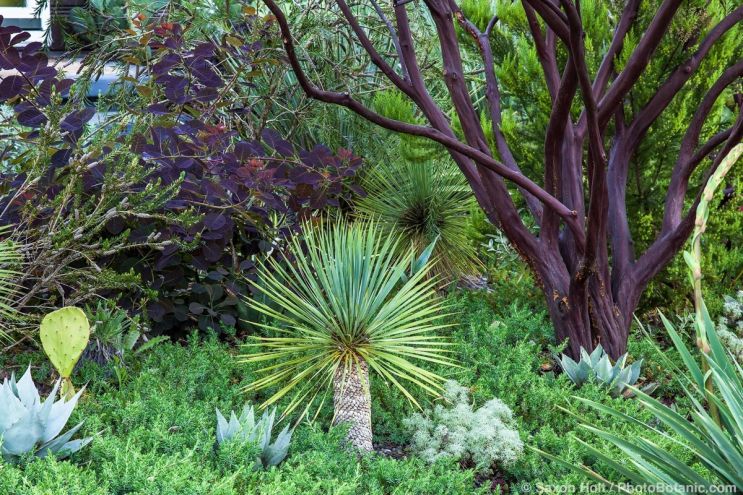
Here in Loree Bohl’s summer garden in Portland, we see a California manzanita ‘Austin Grifiths’, shore juniper from Asia, Yucca rostrata from Texas, and purple smokebush from Eurasia, among many other choice plants.
Next, Southern California in July:

In The Huntington Library’s desert garden, a Ponytail Palm from Mexico (Beaucarnea recurvata), is framed by a South American Jelly palm (Butia capitata), and tall Yucca rostrata in front of a gloriously flowering yellow-flowered palo verde tree (Parkinsonia x ‘Desert Museum’).
Finally, a Northern California meadow garden by John Greenlee in high summer:

With plants from around the world, this meadow garden starts with a North African grass Atlas Fescue (Festuca mairei), includes Spanish lavender (Lavandula stoechas), Texas hummingbird mint (Agastache cana), and purple top vervain (Verbena bonariensis) from South America.
It is our great pleasure to share these creative plant combinations adapted to their own summer-dry climates.
Get More Ideas in our Book
Links We Like
Climate Tool Box: A collection of web tools for visualizing past and projected climate.
We would love to hear about any resources you would like to pass along. We all get these snippets from our news feeds and inboxes. Let’s share the best, and we will keep the running list so you can find them later on the Links We Like page.

Share This!
Related Articles

By: Saxon Holt

By: Saxon Holt