Aloes
Share This!
There are more than 400 species of Aloe, and hundreds of named cultivars. All Aloes come from Africa, or the Arabian peninsula and many are adapted to summer-dry climates, so long as they are given sharp drainage.
We featured Aloe striata in a blog a few months ago but thought we would do a visual survey for our article this month.

Aloe marlothii flowering in Aloes in Wonderland, Santa Barbara, California
Cold weather hardiness for Aloes, and indeed most succulents, is certainly an issue but for many of us in summer-dry climates, where we seldom have sustained hard freezes, wet soggy winters are more of a cultural concern than cold.
Some Aloe actually originate in mountains, which is why Aloe marlothii has the common name of mountain aloe, and Aloe aristata, seen here with its beautiful knobby leaves, even takes the snow in its native Drakensberg mountains.

Nevertheless in the summer-dry climates of the Pacific West Coast we seldom see Aloe outside of Southern California. They simply don’t like even moderately cold weather when it’s wet.
Brian Kemble, Curator at the Ruth Bancroft Garden in Northern California, has a number of his own outstanding Aloe hybrids in the garden but you will note they are all in well maintained gravelly mounds and many of the most tender are covered when frost is expected.
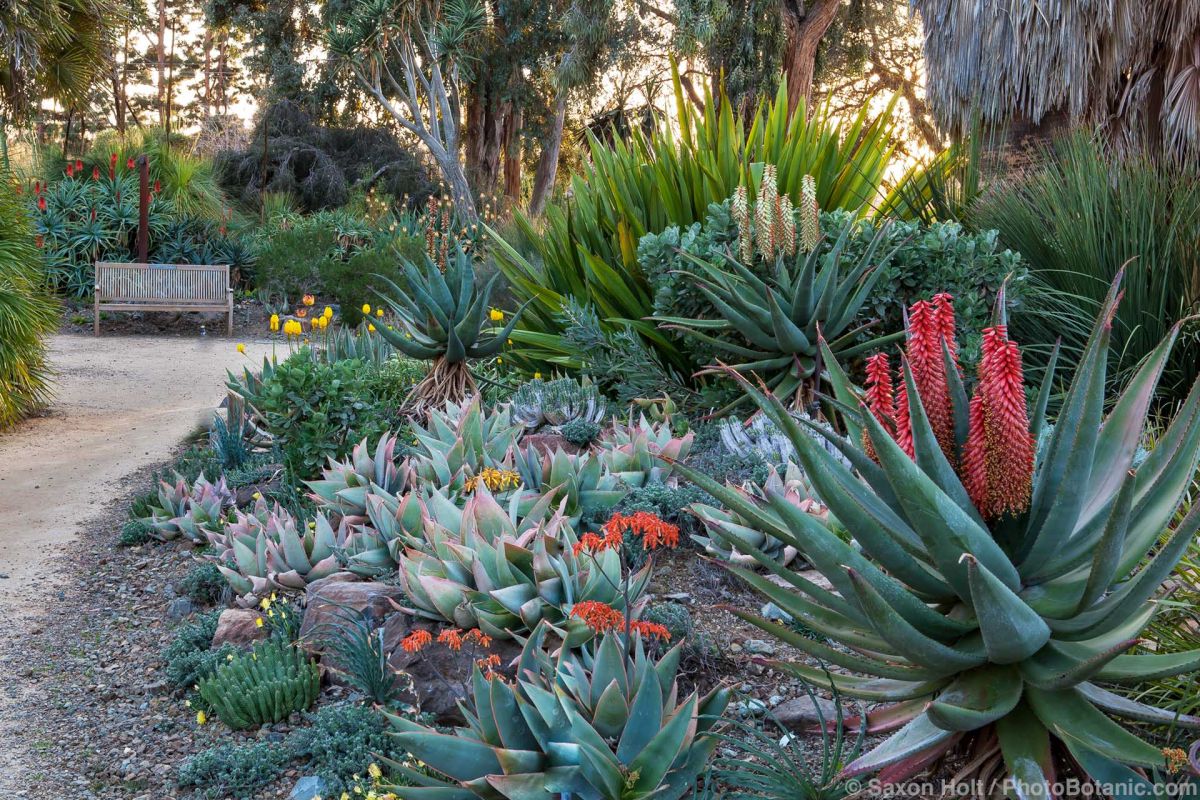
Aloes in raised gravel mounded beds at the Ruth Bancroft Garden in Walnut Creek, California
Winter is a good time to visit the Ruth Bancroft Garden to see how they protect their tender plants but is also a time when the aloes are in bloom and a great chance to see some of Brian’s own Aloe cultivars such as this ‘Creamsickle’.

Aloe ‘Creamsicle’ flowering in Ruth Bancroft Garden
Brian Kemble’s list of Hardy Aloes on San Marcos Growers website.
Even though aloe may be hardy in your location be vigilant about providing good drainage. For those of you outside of the range of aloes or simply don’t have space for some of the larger ones we hope you will follow along with this photo blog. Aloes are truly spectacular plants, especially as many of them bloom in the winter. They are really, really useful in very dry gardens.
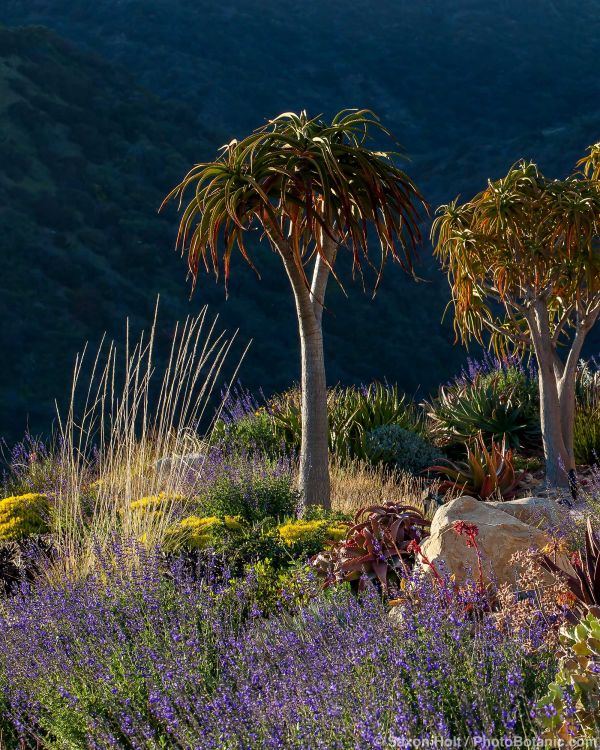
Aloe bainesii with Muhlenbergia lindheimeri ‘Autumn Glow’ Muhly grass in Southern California hillside designed by Urban Water Group
Did we mention some get quite tall? Above we see Aloe bainsii (or its new name: Aloidendron barberae) which can get as tall as small tree and makes a wonderful accent point in the gardens that can handle them. If you have the climate for Aloe, do be aware, like most succulents found in a nursery display, they can get large, and quickly. Consult your garden resources such as our book Gardening in Summer-Dry Climates to understand the different habits.
Succulents do transplant fairly easily, so if you get them in the ground and find them to be in the wrong place move them before they get too big and bulky. Not only do some Aloe get quite tall others can spread and almost be a massive ground cover like this Aloe ciliaris.

Aloe ciliaris (Aloiampelos ciliaris), sprawling over retaining wall.
And speaking of spreading, next in the succulent section of San Francisco Botanical Garden, we see Aloe arborescens has spread out covering an entire hillside.

Most often though, and in private gardens, an Aloe stands alone and makes its own statement. A small one like this hybrid named ‘Little Red Riding Hood’ makes a great focal point in the garden; and when wildflowers and grasses are allowed to surround it such as Verbena bipinnatifida at the Huntington Library Garden in Southern California, their architectural shape really stands out.
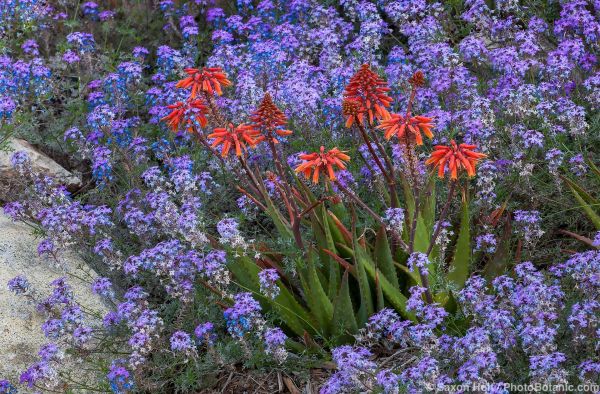
The Huntington library garden is a fabulous resource for gardeners in summer-dry climates. It is certainly a visual treat for anyone but the individual plant vignettes can be applied in smaller scale gardens too. However, without space some of their plantings would be impossible to replicate – such as this new meadow or ‘succulent bushland’ using Cape aloe (Aloe ferox) and Atlas fescue (Festuca mairei).

Succulent bushland with Aloe ferox and grasses
That grassland is such a clever combination of plants and speaks to the versatility that aloes. More and more gardeners are turning to succulents as drought tolerant solutions to more thirsty plant combinations. Aloes pair beautifully with other succulents as different ones grow together and mix up their foliage colors and mimic leaf patterns.

Aloe striata (Coral Aloe), with Senecio serpens, Blue Chalksticks, and Agave lophantha
Let’s finish off this visual survey with where we began, with this majestic Mountain Aloe, Aloe marlothii in Patrick Anderson’s southern California garden.


Share This!
Related Articles

By: web@thegardenofwords.com

By: Nora Harlow

By: Nora Harlow