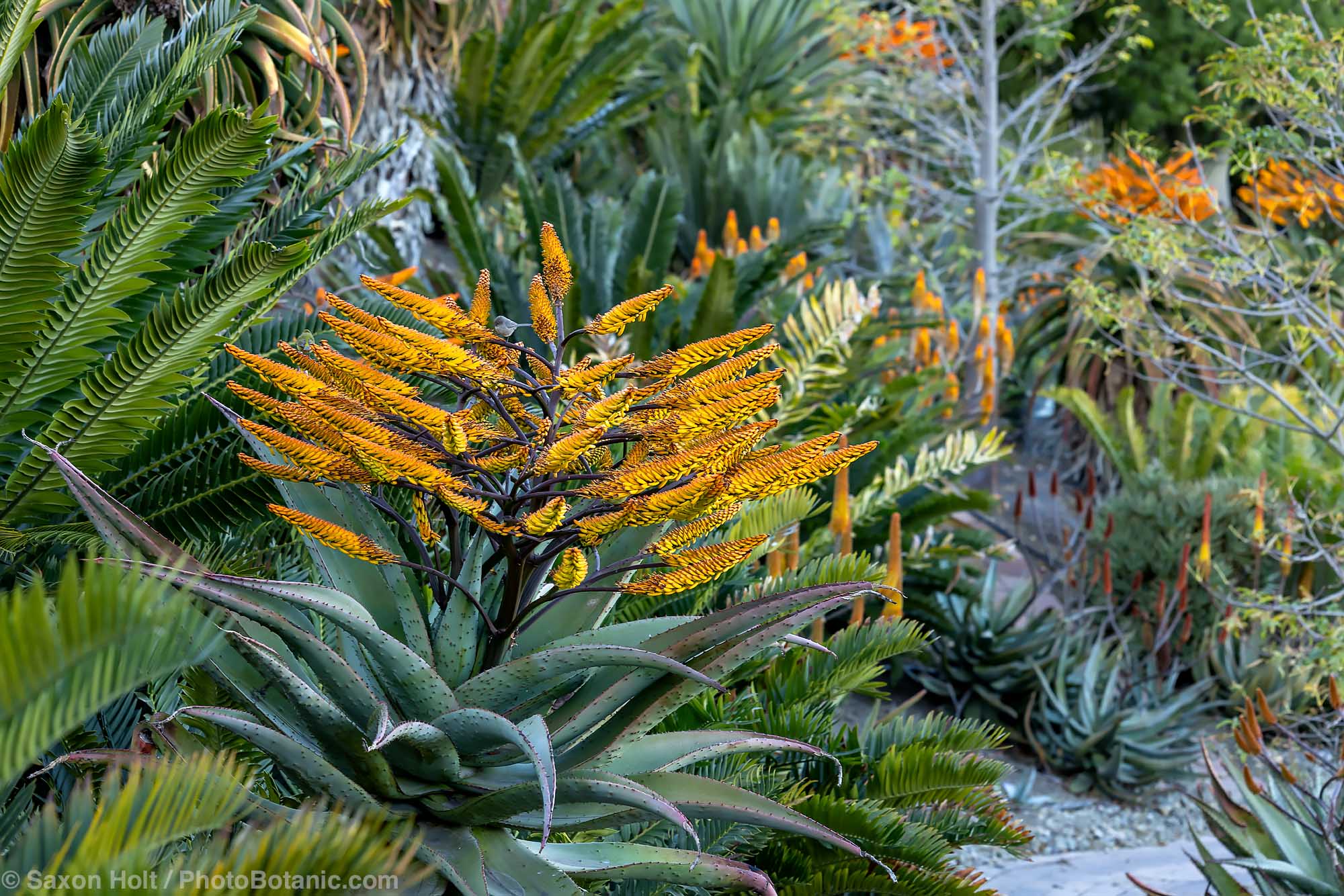
Aloe striata: a Standout Landscape Plant
Share This!
It can be difficult to stand out among the hundreds of aloe species and their many hybrids of known, unknown, or uncertain parentage. Virtually all aloes are at least interesting and many are supremely beautiful, especially in bloom. Aloe striata stands out simply as a choice landscape plant, appreciated by gardeners and landscape designers for the ease with which it can be incorporated into a cohesive, low-maintenance landscape design.
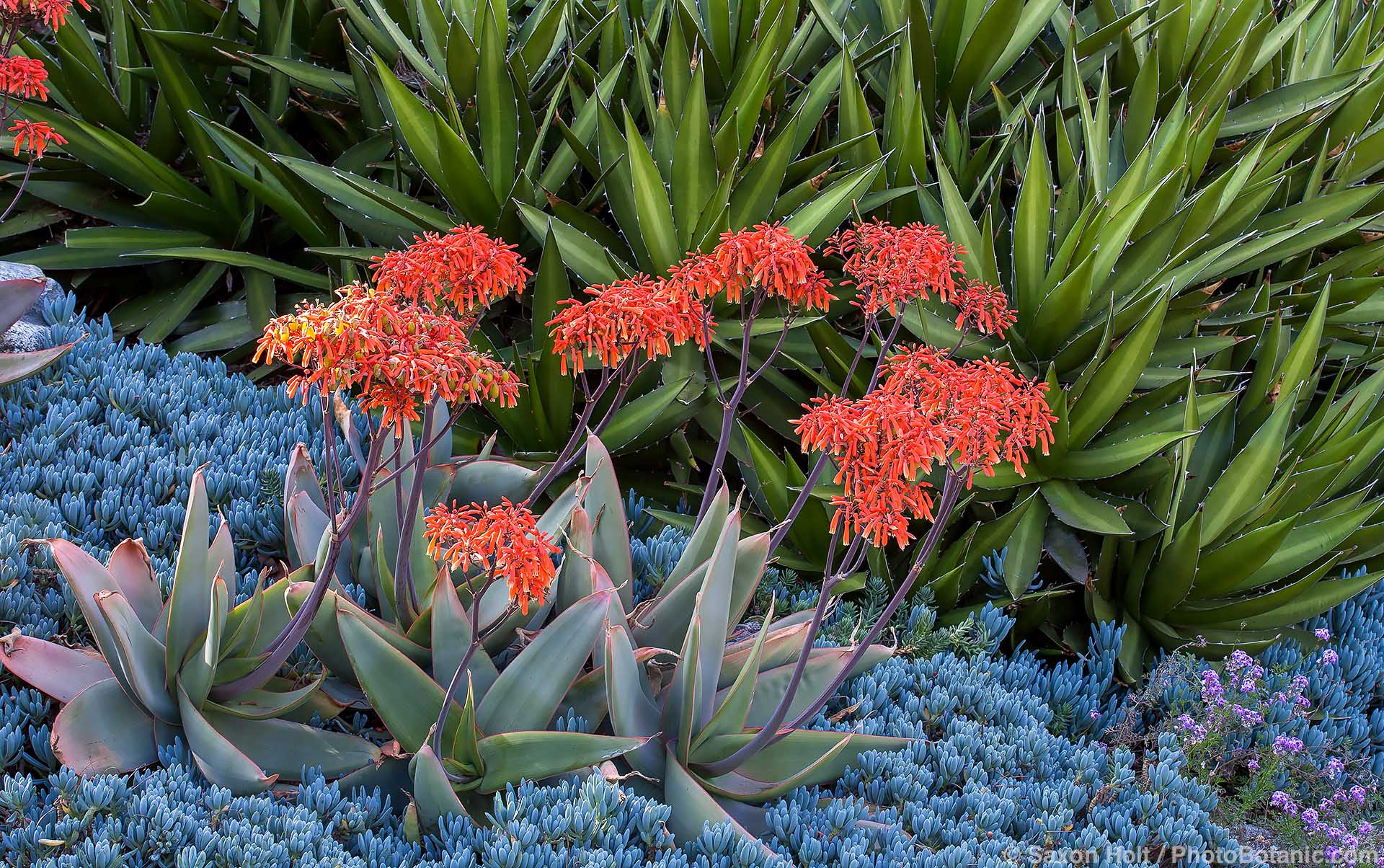
Aloe striata adds a pop of color to a display at the Huntington Botanical Gardens in Los Angeles.
Aloe striata is a mid-sized member of the genus, neither so small as to be overwhelmed by other plants nor so large as to outcompete them. At 18 inches tall and 1-2 feet wide, it is a perfect size for combining with other landscape plants. Unlike many other aloes, A. striata forms offsets or “pups” only occasionally so it tends to remain a single rosette of flat, broad, pale gray-green leaves that does not expand much in place.
Also unlike many aloes, the leaves of Aloe striata have smooth margins without teeth or spines so working among them is pleasantly danger-free. Leaf surfaces have subtle but noticeable darker green parallel lines running lengthwise and leaf margins are pale pink and almost transparent. Leaves change color with exposure, taking on pinkish tones in full sun and turning bluish gray-green in part shade. The plant is attractive both in and out of flower.

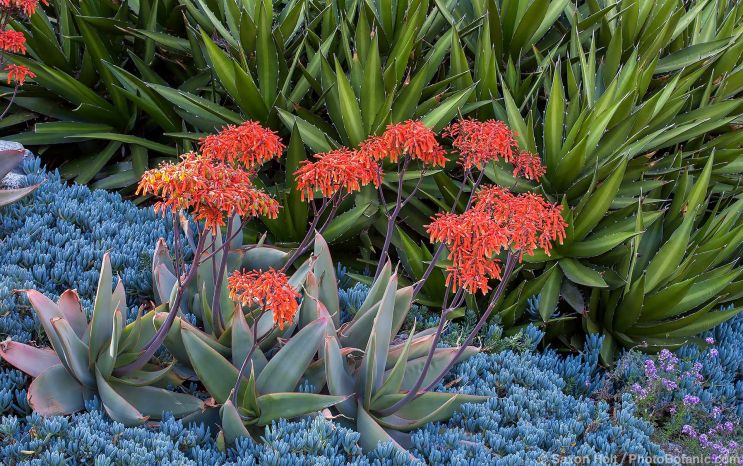
Aloe striata is easily worked into a pleasing design, here with Lotus hirsutus at the Ruth Bancroft Garden in Walnut Creek, California.
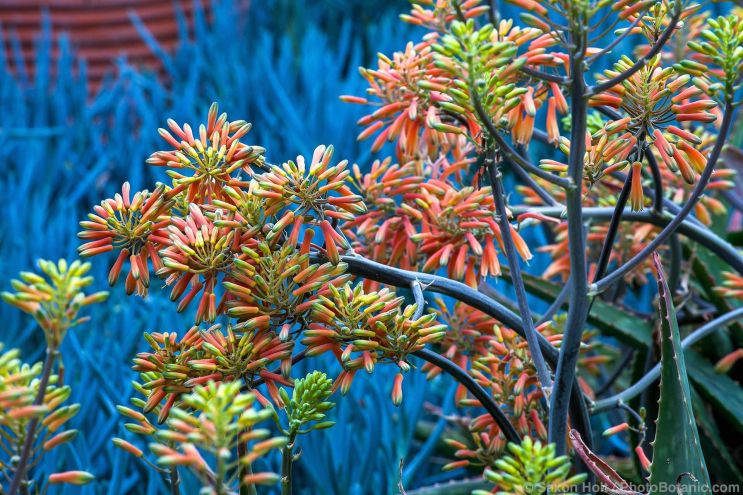
Unlike some of the better known aloes such as Aloe arborescens or A. ferox, the tubular, red-orange, winter flowers of A. striata are held in loose, rounded clusters atop the branched stems rather than in upright, cylindrical spikes. This gives the plant a relaxed and informal look that both lends itself to a naturalistic landscape design and provides appealing contrast in a more formal arrangement.
Aloe striata consists of three subspecies, two of which are offered in the trade. The most commonly available is subspecies striata, which is native to dry, rocky, well-drained soils in South Africa’s southern Western Cape and Eastern Cape provinces north to Namibia both along the coast and into the arid karoo. Subspecies karasbergensis is a somewhat larger plant with longer leaves, more prominent striations on leaf surfaces, and dark pink to red flowers. It is native to the arid mountains of the Northern Cape and southern Namibia.
Plants offered by nurseries as Aloe striata sometimes are instead a hybrid, initially of garden origin, presumed to involve A. maculata and in the trade since the early 1900s. These may be marketed as Aloe Striata Hybrid, as Aloe striata ‘Ghost Aloe’, or simply as Ghost Aloe.
Aloe maculata is native to southern Africa from Zimbabwe and Botswana west to southern and eastern South Africa. It shares with A. striata the broad, flat, gray-green leaves and the rounded or flat-topped flowerheads, but its sharply toothed leaves have white spots instead of green striations, it blooms in summer, and it pups freely. Unlike A. striata, ‘Ghost Aloe’ hybrids have fine teeth along pinkish leaf margins and do produce offsets.
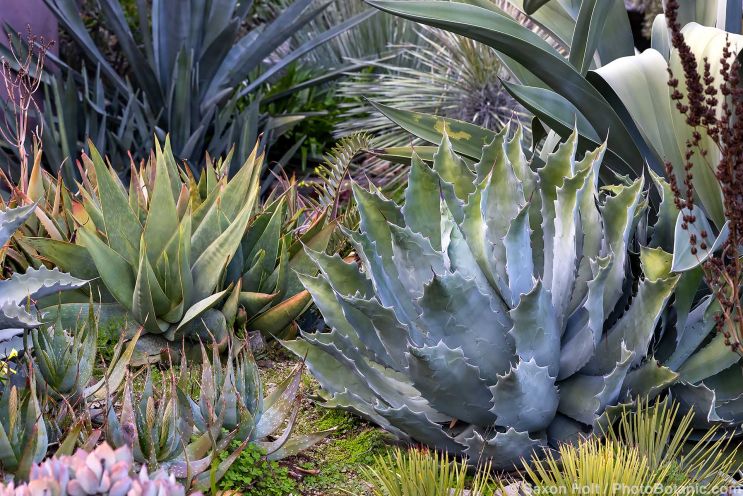
Aloe striata x buhrii (left) with Agave potatorum (right, front) in a northern California landscape by Enchanting Planting
A hybrid of Aloe striata and A. buhrii created by plantsman Brian Kemble of the Ruth Bancroft Garden in Walnut Creek has smooth, red-margined, gray-green leaves with faint white spots similar to those of A. buhrii. With yellow to orange flowers in spring, A. buhrii is native to the dry western karoo of South Africa’s Northern Cape Province. The hybrid does not seem to be widely available.
Aloe striata and its hybrids are reported to be more cold hardy than many other aloes, but we can assume that these southern African succulents will tolerate temperatures only down to the mid-20 degrees F., especially if freezing is prolonged. In the San Francisco Bay Area my plants have shown no damage from winter weather, but northern California has not recently experienced the lows we had in the mid-1990s before my plants were installed.
Drainage, which must be near perfect, seems to be the key to successful cultivation. Overhead watering followed by sun exposure will burn the leaves. Wait until plants are in shade to water.

Share This!
Related Articles

By: Saxon Holt

By: Saxon Holt